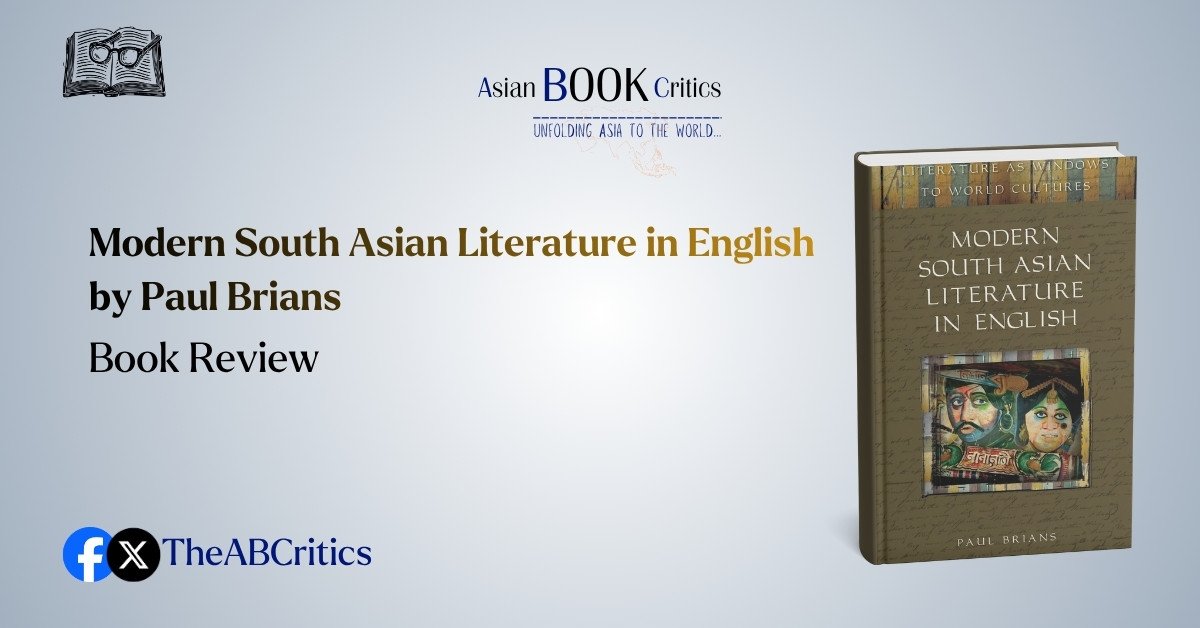
Book: Modern South Asian Literature in English
Author: Paul Brians
Publication Details: Greenwood Press, 2003 – 247 pages
Genre: Academic, Criticism
Paul Brians’ Modern South Asian Literature in English is one of those books that arrive with a modest academic promise and gradually reveal themselves as a far more consequential literary intervention. At first glance, the volume appears to be a guided introduction to South Asian writing in English for beginners, students, and general readers. The structure is pedagogical, the language direct, and the intention openly explanatory. Yet beneath this apparently introductory surface lies a carefully mediated intellectual argument about literature, cultural representation, colonial inheritance, and the politics of reading. Brians is not merely cataloguing writers from India, Pakistan, and Sri Lanka. He is trying to construct a bridge between South Asian literary traditions and Western readerships who often approach the region through stereotypes, selective fascination, or inherited Orientalist curiosity. The remarkable thing is that he attempts this difficult balancing act without slipping fully into either academic obscurity or touristic simplification. That achievement alone makes this book worthy of serious consideration.
The book emerges from an important historical moment. Published in 2003, it belongs to a period when South Asian writing in English had already acquired global visibility through figures such as Salman Rushdie, Arundhati Roy, Bharati Mukherjee, Rohinton Mistry, and Jhumpa Lahiri, yet the broader literary genealogy behind these celebrated figures remained insufficiently understood by ordinary readers. Brians recognises this gap immediately in the introduction, where he observes that South Asian culture had become “chic in the West” while literature from the region was simultaneously enjoying a growing international readership. What is notable here is not the statement itself, but the critical caution attached to it. Brians never allows enthusiasm to become an uncritical celebration. Again and again, he reminds the reader that English-language South Asian fiction represents only one stream among many literary cultures thriving in dozens of languages across the subcontinent. He candidly acknowledges the resentment often felt by critics who believe that English-language authors “pander to the West” through exoticism and explanatory glosses. This intellectual honesty becomes the moral backbone of the entire volume. The book does not romanticise South Asian literature as a mystical or monolithic phenomenon. Instead, it repeatedly emphasises plurality, contradiction, fragmentation, and competing realities. Brians writes with the temperament of a teacher who knows that simplification is necessary, but oversimplification is dangerous.
One of the greatest strengths of the book lies in its method of literary exposition. Each chapter combines biography, historical background, thematic analysis, interpretive guidance, and contextual explanation in a manner that remains accessible without becoming intellectually shallow. This is especially visible in the lengthy discussion of Rabindranath Tagore and the Quartet. Brians approaches Tagore not as a distant icon embalmed in Nobel Prize reverence, but as a restless, contradictory, emotionally complex modern writer negotiating tradition, colonial modernity, spirituality, sexuality, caste anxieties, and artistic experimentation. The discussion is expansive and remarkably attentive to cultural nuance. When Brians explains the caste system, Vaishnava devotionalism, widowhood, or the emotional and symbolic dimensions of Hindu practices, he does so not merely to educate Western readers but to illuminate the psychological architecture of Tagore’s fiction. The explanatory passages never feel mechanically inserted. They organically serve literary interpretation. For instance, his observation regarding Tagore’s fiction that “human love is portrayed as the ultimate force that drives his characters” becomes the key through which the emotional tensions of Quartet are unpacked. Likewise, his discussion of Damini, Sachish, and Sribilash is not reduced to a simplistic love triangle. Brians interprets their interactions through the conflicting pulls of ascetic spirituality, sensuality, social convention, and emotional hunger. The result is criticism that remains humane instead of merely theoretical.
There is another quality in these readings that deserves appreciation. Brians consistently resists the temptation of interpretive arrogance. Many academic critics approach South Asian texts with excessive theoretical apparatus, reducing novels into illustrations of postcolonial terminology. Brians certainly acknowledges postcolonial criticism and even recommends introductory works on the subject, yet he never allows jargon to suffocate the literary experience. His prose remains lucid because he fundamentally believes literature must first be read as literature. This conviction is visible when he remarks that fiction exists “to reshape human experiences and feelings, to tell satisfying or disturbing stories, to amuse, excite, intrigue, challenge, and move the reader.” That statement may appear simple, but in the current academic climate, it sounds almost radical. Brians restores emotional engagement to literary criticism without sacrificing analytical seriousness. In this respect, the book recalls the older tradition of humane criticism associated with figures like E. M. Forster or William Walsh rather than the dense abstraction dominating many university departments today.
The structural organisation of the volume also deserves attention. Brians carefully selects texts that collectively map the evolution of South Asian fiction in English across regions, communities, genders, and narrative styles. The inclusion of writers such as Raja Rao, Khushwant Singh, Attia Hosain, Bapsi Sidhwa, Anita Desai, Salman Rushdie, Rohinton Mistry, Arundhati Roy, Michael Ondaatje, and Jhumpa Lahiri creates a literary mosaic rather than a rigid canon. Particularly impressive is his awareness that South Asian reality cannot be homogenised. At one point, he explicitly observes, “It would be absurd to refer to ‘the South Asian reality.’ There is no such thing.” This insight becomes the philosophical centre of the book. Brians repeatedly foregrounds difference: Hindu, Muslim, Sikh, Buddhist, Parsi; rural and urban; nationalist and cosmopolitan; realist and experimental; elite and marginal. Such plurality protects the work from becoming a flattened cultural survey.
The chapter on Tagore further demonstrates Brians’ remarkable ability to synthesise literary history with interpretive sensitivity. His account of Tagore’s relationship with Kadambari Devi is especially moving because it avoids sensationalism while acknowledging emotional intensity. Brians notes that Tagore returned “obsessively in his fiction to love triangles and other forbidden passions.” This biographical insight becomes essential for understanding the tragic emotional configurations recurring in Quartet and The Broken Nest. Similarly, his explanation of the tension between Brahmo rationalism and Vaishnava spirituality deepens the reader’s comprehension of Tagore’s inner conflicts. What emerges from these passages is not merely information but a sense of literary atmosphere. Brians has the rare gift of making readers feel why cultural context matters to interpretation.
His reading of Damini remains among the most memorable sections of the book. Brians observes that “Damini didn’t embellish the songs any more; the songs embellished her.” This sentence, quoted from the novel and interpreted by Brians, captures not only Damini’s disruptive sensual power but also Tagore’s broader fascination with women who destabilise spiritual certainties. Brians understands that Tagore’s women are neither simple victims nor uncomplicated rebels. They occupy emotionally volatile spaces where desire, duty, sacrifice, social stigma, and spiritual yearning collide. Such interpretive attentiveness distinguishes serious criticism from superficial commentary.
At the same time, the book is not free from limitations, and acknowledging them is necessary if one wishes to assess it fairly. The most visible limitation is its inevitable dependence on the framework of English-language literary circulation. Brians openly admits that his focus excludes vast traditions of South Asian writing in regional languages. While this honesty is commendable, the structural imbalance remains. A reader unfamiliar with Indian literary culture may still come away with the impression that English-language fiction constitutes the principal representative voice of South Asia. Brians attempts to counter this danger through repeated qualifications, yet the publishing market and institutional framework surrounding the book reinforce the very hierarchy he critiques. In this sense, the volume participates in the global literary economy it simultaneously analyses.
Moreover, any ardent student of literature must be curious (or rather intrigued and bemused with a vague expression on his face) about the choice of inclusions in this book. What exactly does the author look for when he locates the literature to fit in his modernity framework? The exclusion of poets (in general) might not make much sense because literature, when we discuss, cannot be bereaved of poetry and yet boast of a collective consciousness, so grand as being branded South Asian Literature! Though we cannot woe over this exclusion of poets for long, as the author qualifies his inclusions in the brackets of ‘fiction’. However, even within the framework of modern fiction, setting aside the champion of the poor and their rise to match steps with those in power and political strength, the author of Coolie, Mulk Raj Anand, remains in question.
Another limitation emerges from the occasionally uneven depth of treatment. Certain authors receive richly layered discussions, while others appear compressed into more functional summaries. This imbalance is understandable in a survey text, but it sometimes leaves the reader wishing for greater engagement with stylistic complexity, especially in writers like Rushdie or Ondaatje. Brians often prioritises accessibility over interpretive density. For beginners, this is undoubtedly beneficial. For advanced readers, however, some analyses may appear introductory rather than probing. Yet even here, the limitation is partly strategic rather than intellectual. Brians clearly intends the book to function as a doorway rather than a terminal destination.
There is also the question of tone. At times, the prose carries traces of an explanatory Western academic voice addressing presumed outsiders to South Asian culture. Although Brians is generally careful and respectful, certain descriptions occasionally risk reinforcing the very ethnographic distance he seeks to dismantle. Nevertheless, compared to many Western critical accounts of non-Western literatures, Brians remains strikingly self-aware. He repeatedly warns readers against treating fiction as documentary anthropology and insists that novels are imaginative reshaping rather than sociological transcripts. His statement that “fiction may not tell us the whole truth about people, but it may make us care about them” is perhaps the ethical key to the entire book.
One of the most admirable dimensions of the volume is its pedagogical generosity. Brians never writes to intimidate. He writes to invite. The glossary, contextual notes, bibliographies, and explanatory passages all reveal a teacher deeply invested in expanding literary access. In an age when literary criticism often performs sophistication instead of cultivating understanding, this generosity feels refreshing. The reader senses throughout the book that Brians genuinely loves these texts and wishes others to love them too. That emotional sincerity prevents the work from becoming dry academic scaffolding.
The usefulness of the book today remains substantial despite changes in the literary landscape since 2003. Contemporary readers may notice the absence of many younger voices now central to discussions of South Asian literature, but the framework Brians constructs still offers an excellent foundation for approaching the field. His emphasis on history, language politics, colonial inheritance, migration, caste, religion, and gender remains deeply relevant. More importantly, the book encourages a mode of reading that is simultaneously empathetic and critical. It teaches readers how to enter unfamiliar literary worlds without reducing them either to exotic spectacle or ideological formula.
Perhaps the finest achievement of Modern South Asian Literature in English lies in the balance it sustains between admiration and scrutiny. Brians neither worships South Asian literature nor patronises it. He approaches it with curiosity, seriousness, and interpretive patience. The result is a study that retains intellectual dignity without sacrificing readability. Even when one disagrees with particular emphases or omissions, one cannot deny the sincerity and labour underlying the work.
In the end, this book succeeds because it recognises something essential about literature itself. Brians understands that literary works are not museum artefacts frozen inside national categories. They are living emotional negotiations between history and imagination, language and silence, identity and desire. Through his readings of Tagore, Raja Rao, Mistry, Roy, and others, he demonstrates how South Asian fiction in English became one of the most vibrant sites for exploring the anxieties and possibilities of modernity. The book may be introductory in format, but its implications are far-reaching. It invites readers not merely to learn about South Asia, but to encounter the complexities of human experience refracted through its literary voices.
That is why the volume deserves continued readership. It remains one of those rare critical studies that can educate beginners, stimulate serious readers, and still offer interpretive insights to seasoned scholars. Its limitations are real, but they arise largely from the immense difficulty of the task it undertakes. To introduce the vastness of South Asian literature within a single volume without descending into superficiality is nearly impossible. Brians does not entirely overcome that impossibility, but he comes impressively close. For readers seeking an intelligent, humane, and accessible entry into modern South Asian fiction in English, this book remains an invaluable companion.
By Dr Alok Mishra
Poet and literary critic
Teaching English Literature at Nava Nalanda Mahavihara