
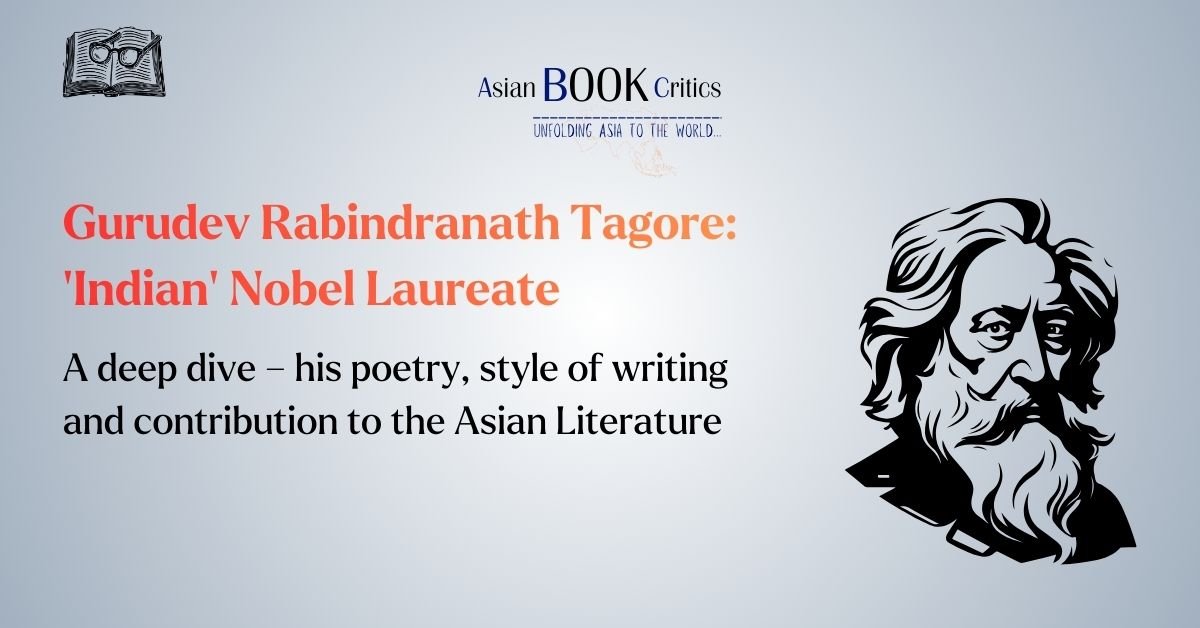
Gurudev Rabindranath Tagore occupies a singular position in the cultural and intellectual history of Asia. As the first Asian to win the Nobel Prize in Literature in 1913, he did far more than achieve individual distinction. He altered how Asia was perceived in the global literary imagination and how Asia began to speak to itself across borders of language, religion, and nation. Tagore was not merely an Indian writer who happened to gain international recognition. He was an Asian thinker in the deepest sense, rooted in the continent’s spiritual and philosophical traditions while remaining open to dialogue with the wider world. His literary achievement cannot be separated from his ethical vision, his educational experiments, and his tireless efforts to build cultural bridges across Asia.
Born in 1861 into a distinguished Bengali family in Calcutta, Tagore grew up in an environment characterised by reformist thought, artistic expression, and intellectual openness. The Tagore household was a meeting place for poets, musicians, philosophers, and social reformers. Yet his education was unconventional. He resisted formal schooling and instead absorbed knowledge through reading, travel, observation, and creative practice. This formative freedom shaped his later conviction that learning must be organic, humane, and connected to life rather than mechanical instruction. From early on, Tagore wrote poetry, plays, songs, essays, and fiction with extraordinary fluency, treating literature not as a specialised craft but as an extension of living thought.
Tagore’s literary range was vast. He wrote poetry that reshaped modern Bengali verse, short stories that introduced psychological realism into Indian fiction, novels that examined the tensions between tradition and modernity, and plays that fused symbolism with social critique. His songs, collectively known as Rabindra Sangeet, form a cornerstone of Bengali cultural life and remain unmatched in their emotional and philosophical depth. Yet it was Gitanjali, translated into English by Tagore himself, that brought him global recognition. The Nobel committee praised the work for its “profoundly sensitive, fresh and beautiful verse,” but the prize was also a recognition of something larger. It signalled the arrival of Asian spiritual and literary expression on the world stage, not as an exotic curiosity but as a source of universal human insight.
What made Tagore’s writing resonate so deeply beyond India was its rooted universality. His poetry drew from the Upanishadic tradition, the Bhakti movement, and Vaishnava mysticism, yet it spoke in a voice free from dogma. He wrote of the divine not as an abstract authority but as an intimate presence in nature, labour, love, and suffering. This vision aligned closely with broader Asian spiritual traditions, including Buddhist compassion, Taoist harmony, and Confucian ethics. Readers across Asia recognised in Tagore’s work a shared sensibility that valued balance, humility, and inner freedom over domination or conquest. His writing offered an alternative modernity, one that did not require abandoning spiritual depth.
Tagore’s novels, such as Gora, Ghare-Baire (The Home and the World), and Chaturanga, examined the ethical dilemmas of a society in transition. He was deeply critical of blind nationalism, warning against turning political freedom into a new form of spiritual enslavement. In The Home and the World, he explored how nationalism, when severed from moral responsibility, can destroy personal relationships and ethical clarity. These concerns were not limited to India. Tagore saw nationalism as a global danger, particularly in Asia, where colonial trauma risked being replaced by narrow chauvinism. His warnings found attentive audiences in Japan, China, and Southeast Asia, where intellectuals were grappling with similar tensions between tradition, modernity, and political assertion.
His short stories remain among his most enduring contributions to world literature. Stories such as Kabuliwala, The Postmaster, The Homecoming, and Punishment portray ordinary lives with extraordinary emotional precision. Tagore brought dignity to marginal figures, women, children, the poor, and the socially constrained. He avoided melodrama and moral preaching, allowing quiet moments and subtle gestures to reveal injustice and longing. In doing so, he laid the foundations for modern Asian short fiction, influencing writers far beyond Bengal. His focus on interiority, social realism, and ethical ambiguity anticipated narrative techniques that later became central to twentieth-century Asian literature.
Tagore’s contribution to Asian literature extended well beyond the written word. He was a tireless traveller and cultural ambassador who believed that Asia must rediscover its interconnected intellectual heritage. He visited Japan, China, Southeast Asia, and the Middle East, engaging in dialogue with scholars, artists, and political thinkers. In China, his ideas sparked intense debate. While some criticised him for idealism, others recognised the value of his call for cultural self-respect without insularity. Tagore urged Asian societies to learn from one another rather than merely imitate the West or retreat into defensive traditionalism. His essays on civilisation, culture, and education articulated a vision of Asia as a space of ethical and spiritual dialogue rather than competition.
One of Tagore’s most enduring contributions to Asian intellectual life was his educational experiment at Santiniketan, later expanded into Visva-Bharati University. Tagore conceived Visva-Bharati as a meeting place of cultures, where “the world makes its home in a single nest.” Scholars from China, Japan, Sri Lanka, and other parts of Asia taught and studied there, creating one of the earliest institutional spaces for pan-Asian exchange. At a time when colonial education systems often prioritised European knowledge while marginalising Asian traditions, Tagore insisted on mutual respect among cultures. Visva-Bharati embodied his belief that literature, philosophy, art, and education must work together to cultivate ethical human beings.
Tagore’s influence on Asian writers is often indirect but profound. His humanism, emphasis on moral imagination, and resistance to rigid ideologies resonated with figures such as Lu Xun in China, Yasunari Kawabata in Japan, and later Southeast Asian writers who sought literary forms capable of expressing both social change and spiritual depth. While stylistic affinities vary, Tagore’s insistence that literature must engage with life rather than abstract theory left a lasting imprint. He demonstrated that Asian writing could address modern anxieties without surrendering its ethical and cultural inheritance.
It is also essential to acknowledge Tagore’s critical engagement with the West. He admired European literature, particularly Romantic poetry, but rejected cultural hierarchy. His exchanges with thinkers such as W B Yeats, Albert Einstein, and Romain Rolland were dialogues rather than acts of intellectual submission. Tagore’s Asian ethos lay in this balanced engagement. He neither rejected modernity nor accepted it uncritically. Instead, he sought a synthesis grounded in compassion, creativity, and ethical responsibility. This stance offered Asian writers a model for engaging global modernity without erasing local identities.
Tagore’s political thought, though often misunderstood, was deeply ethical. He supported freedom from colonial rule but remained sceptical of mass politics driven by anger or exclusion. His critique of nationalism was particularly relevant to Asia, where anti-colonial movements risked reproducing authoritarian structures. He believed that true freedom must be rooted in self-discipline, mutual respect, and cultural renewal. This philosophy influenced Asian intellectual debates on independence, governance, and cultural identity, even when his views provoked disagreement.
The Nobel Prize amplified Tagore’s voice, but it did not define his achievement. He continued to write prolifically after 1913, producing poetry marked by increasing introspection and philosophical depth. His later works grapple with mortality, doubt, and the limits of language itself. These writings reveal a thinker unafraid of uncertainty, a quality that aligns closely with Asian philosophical traditions that value questioning over final answers.
Today, Tagore’s relevance extends beyond literary history. In an Asia marked by rapid economic growth, political tension, and cultural anxiety, his insistence on humanism, dialogue, and ethical imagination remains urgently needed. He reminds readers that literature is not merely a record of achievement but a practice of understanding. His work urges Asia to see itself not as a collection of competing nations but as a shared moral and cultural space enriched by diversity.
To read Rabindranath Tagore is to encounter a vision of Asia that is confident without arrogance, spiritual without dogma, and modern without amnesia. His books, whether poetry, fiction, or essays, continue to offer readers a language for inner freedom and collective responsibility. As the first Asian Nobel laureate in literature, Tagore did more than open a door. He helped build a bridge across continents and centuries, inviting Asia to speak in its own voice while listening carefully to others. That achievement, grounded in both artistic excellence and ethical courage, secures his place not only in Indian literature but in the shared literary heritage of Asia and the world.



1 Comment. Leave new
thanks for info.