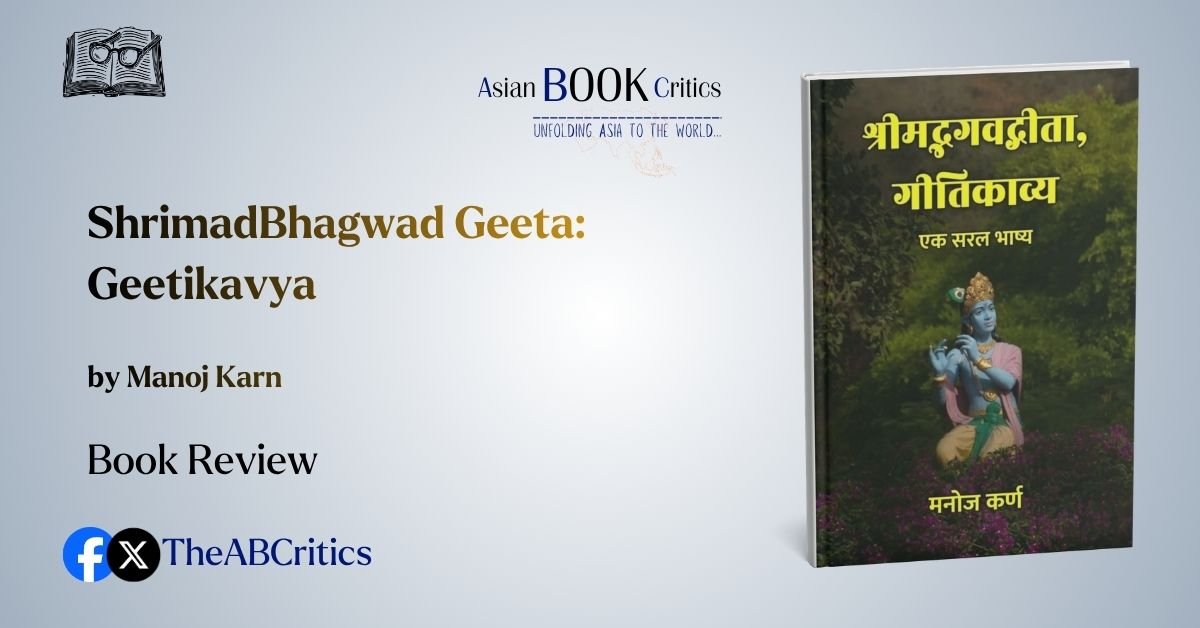
In the contemporary socio-cultural climate, characterised by relentless digital distractions, acute psychological stress, and rapid ethical fragmentation, the search for grounded moral philosophy has become an urgent necessity rather than an academic luxury. Manoj Karna’s Shrimad Bhagavad Gita, Geetikavya: Ek Saral Bhashya emerges precisely as such a vital, simplified, and timely literary intervention. Rather than treating the ancient scripture as an intimidating theological relic, Karna presents the Bhagavad Gita as a practical, everyday guidebook for living, moral discernment, and emotional stability. The necessity of such a work is firmly rooted in modern social realities, where young individuals and busy householders often struggle to find clear ethical orientation amidst worldly challenges. In his authorial introduction, Karna underscores that the teachings of Lord Krishna offer a comprehensive framework for mental equilibrium and righteous action, serving as an inner medicine for psychological afflictions. This framing aligns seamlessly with a landmark ruling from December 2025 by the Madras High Court, which recognised the Bhagavad Gita as an essential moral science whose universal Vedantic principles transcend sectarian divides to form a foundational component of civilisational heritage
. By casting this timeless dialogue into rhythmic, accessible Hindi verse, Karna gives modern society a much-needed tool for character formation, stress relief, and spiritual grounding.
The primary obstacle facing younger generations and readers unfamiliar with Sanskrit prosody is the daunting linguistic and structural complexity of traditional scriptural commentaries. Archaic syntax, dense scholarly footnotes, and complex grammatical constructs frequently alienate novice seekers, creating a formidable barrier between young minds and their philosophical heritage. Karna systematically dismantles this barrier by simplifying core Vedantic doctrines without sacrificing their spiritual dignity or conceptual accuracy. By translating abstract philosophy into lucid, melodious Hindi couplets, he demystifies the text and renders its wisdom immediately approachable. This pedagogical intent is explicitly articulated in the opening composition titled Gita Sirf Dharmagranth Nahin, where Karna redefines the scripture’s role for the contemporary reader:
“गीता सिर्फ धर्मग्रंथ नहीं, यह चेतना का विस्तार है, केवल प्रभु की वाणी नहीं, ईश्वर का शाश्वत प्यार है.. गीता सिर्फ धर्मग्रंथ नहीं, यह मुक्ति का पावन द्वार है, यह औषधि है मनोविकारों का, जीवन का नव श्रृंगार है..”
Through this evocative verse, the poet transforms what might seem like a distant religious code into a relatable therapeutic framework. Young learners are encouraged to view the Gita not as an imposing set of dogmatic rules, but as an expanding horizon of consciousness and a restorative medicine for psychological distress, thereby establishing an immediate personal connection with the text.
The utility of Karna’s simplified poetic methodology is particularly evident in how it illuminates the Gita’s teachings on mind control and self-discipline, topics that are directly relevant to students and young adults navigating personal anxieties and academic pressure. In Chapter Six, Dhyaan Yog, the original Sanskrit shlokas discuss the intricate mechanics of Atma-Samyama and mental restraint, concepts that can easily feel abstract to a beginner. Karna translates these subtle psychological insights into clear, memorable verse that equips young readers with an intuitive understanding of internal mastery. Consider the following stanza from Chapter Six, where Krishna explains the dual nature of the human mind: “मन ही तो मित्र है अपना, और मन ही है शत्रु बन जाता, मन के द्वारा ही मनुष्य, इस जग से है पार उतरता.. मन को जिसने वश में किया, धैर्य रखा और जीत लिया, उसका मन ही इस दुनिया में, उसका सच्चा मित्र हुआ..”. By distilling the classical doctrine into rhythmic, balanced Hindi phrasing, Karna transforms an abstract Vedantic principle into an actionable psychological tool. Young learners unacquainted with Sanskrit syntax can instantly grasp that the disciplined mind is one’s greatest ally, whereas an uncurbed mind becomes one’s fiercest adversary. This clarity empowers readers to internalise self-mastery, focus, and emotional resilience as practical virtues for daily life.
Furthermore, Karna’s simplification excels in rendering abstract metaphysical allegories into vivid, intuitive imagery that makes profound spiritual truths accessible to novice readers. In Chapter Five, Karma Sanyas Yog, the text explores the challenging concept of performing worldly actions with complete detachment, living in society without absorbing its corrupting influences. Rather than entangling the reader in dry academic terminology, Karna employs a classical nature allegory that illuminates the concept through visual metaphor:
“जैसे जल की बूंदें रहतीं, सुंदर कमल के पत्तों पर, छू न पाती जल की धारा, यो बहती सदा ही सतहों पर.. वैसे ही जो, कर्म सुपुर्द करे, ईश्वर के पावन चरणों में, पाप-पुण्य का भेद मिटेगा, पल-पल घटित संस्मरणों में..”
The visual image of water droplets gliding harmlessly across a lotus leaf provides young minds with an immediate, tangible understanding of Nishkam Karma, illustrating how one can fulfil worldly obligations while remaining spiritually unattached. A similar conceptual lucidity appears in Chapter Seven, Jnan Vijnan Yog, where Karna simplifies the complex Vedantic doctrine of cosmic immanence and divine unity through another memorable poetic image:
“मुझसे श्रेष्ठ यहाँ पर अर्जुन.! अन्य कुछ भी, नहीं है जग में, सूत्र में पिरोए मणियों जैसे, सब आश्रित हैं, मेरे पद में..”
By comparing the universe to a collection of precious gems strung together upon a single hidden thread, Karna enables readers unfamiliar with Sanskrit to comprehend high Vedantic metaphysics effortlessly, bridging the gap between subtle ancient philosophy and contemporary reader comprehension.
Manoj Karna distinguishes himself as a literary figure who deliberately looks beyond conventional poetic and commentary approaches. Traditional interpretations of the Bhagavad Gita generally fall into two rigid categories: literal verse-by-verse translations that read like dense academic prose, or highly technical commentaries heavy with sectarian dogma and complex Sanskritized jargon. Rejecting both conventional conventions, Karna adopts a fresh, narrative-driven Geetikavya approach that prioritises emotional resonance, lyrical continuity, and pedagogical utility. He does not merely translate words; he internalises the spiritual essence of each chapter and re-expresses its core emotional narrative through fluid, singable Hindi verse. Moreover, Manoj Karn steps outside traditional boundaries by incorporating original reflective poems that extend the psychological universe of the Mahabharata. Compositions addressing post-war grief, human conscience, and karmic justice demonstrate that Karna views the epic not as a static historical artefact, but as a living, dynamic canvas capable of inspiring new literary and moral exploration.
The success of Karna’s simplified commentary relies heavily on his refined poetic abilities and deliberate metrical choices. Operating within the realm of Geya Kavya, or singable poetry, the author crafts stanzas featuring consistent end-rhymes, balanced line lengths, and a natural rhythmic cadence. These stylistic techniques perform an essential educational function by converting dense philosophical ideas into oral verse that can be easily recited, memorised, and shared within families or classroom environments. Importantly, Karna’s emphasis on simplicity does not lead to linguistic impoverishment. He demonstrates remarkable poetic skill by seamlessly retaining key Sanskrit technical terms, such as Karmanyevadhikaraste, Sthitaprajna, Yoga-Kshema, and Nimitta Matra, while surrounding them with clean Hindi phrasing that clarifies their meaning in context. This harmonious blend of traditional terminology and modern poetic meter ensures that the text maintains its sacred dignity while offering a smooth, musical reading experience.
Beyond its literary craft, the volume offers profound utility as a medium for moral education and intergenerational connection in contemporary society. In an era where traditional value systems are frequently disrupted by rapid technological change, parents and educators often lack accessible materials to impart ethical grounding to children. Karna explicitly addresses this need by designing a book that mothers, grandmothers, and teachers can read aloud to young learners, reviving the traditional practice of home-based ethical instruction. The inclusion of classical Sanskrit adages regarding the foundational role of parents and teachers as sculptors of character highlights the book’s explicit educational ambition. By presenting the Gita as a singable, narrative journey rather than a dry instructional text, Karna creates an engaging medium that fosters moral literacy, cultural awareness, and emotional strength across generations, serving as a stabilising anchor for young minds in a complex world.
In conclusion, Manoj Karna’s Shrimad Bhagavad Gita, Geetikavya: Ek Saral Bhashya stands as an exceptionally effective, beautifully crafted medium for introducing modern readers to the eternal wisdom of the Gita. Through his innovative combination of simplified metrical verse, evocative natural allegories, and original reflective compositions, Karna successfully bridges the gap between ancient Sanskrit philosophy and contemporary reader needs. High appreciation is due to the author for his poetic courage and technical mastery in stepping away from conventional, pedantic commentary models to serve a higher educational purpose. He has created a work that honours the sacred depth of the scripture while rendering it accessible, singable, and deeply relevant for young learners and general readers alike. Karna’s volume is a valuable addition to modern Hindi literature and an indispensable companion for anyone seeking clarity, moral resilience, and spiritual harmony in today’s fast-paced world.
Get a copy of this book from Amazon India – click here.
Review by Alka for Asian Book Critics