
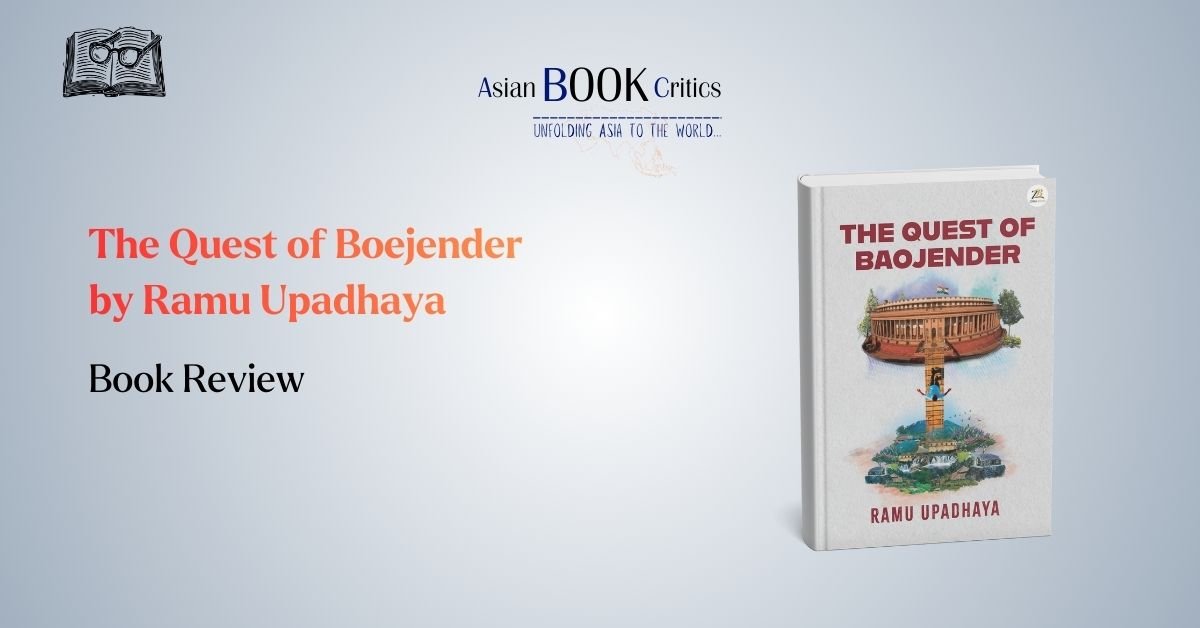
The Quest of Baojender by Ramu Upadhaya — A Reader’s Encounter with a Region Thinking Aloud
Reading The Quest of Baojender by Ramu Upadhaya from a perspective rooted in reader-response and cultural studies reveals the work as an extended act of regional self-articulation rather than a conventional literary performance. This is a book that appears less interested in persuading the reader through narrative charm than in compelling the reader to listen. It speaks in a measured, often uncompromising voice, as though the land itself has assumed human consciousness and begun to record its grievances, hesitations, and moral confusions. From this standpoint, the novel functions as a long, uninterrupted monologue addressed not to characters within the text, but to the reader positioned outside it, especially one unfamiliar with the everyday realities of Northeast India.
What immediately distinguishes The Quest of Baojender is its refusal to flatter the reader. The text does not simplify its context, nor does it offer explanatory pauses to accommodate an uninformed audience. Instead, it expects the reader to adapt to its rhythms, vocabulary, and ethical urgency. This creates an unusual reading experience in which the burden of engagement shifts decisively onto the reader. One is not guided gently into the world of Dima Hasao; one is placed inside it and asked to observe, reflect, and judge. The book thereby challenges the passive consumption often associated with the novel form and replaces it with a demanding intellectual companionship.
From this angle, the protagonist Baojender, also known as Wiso or Charming Posse, may be read not as a character in the traditional sense but as a narrative device that mediates between region and reader. His triple identity does not merely express personal complexity. It performs a structural function by allowing the text to speak in multiple registers. Baojender invokes emotional belonging and spiritual intimacy with the land. Wiso articulates ethical longing and existential dissatisfaction. Charming Posse delivers critique, irony, and political dissection. Together, these personas enable the book to operate simultaneously as confession, commentary, and critique without settling into any one mode.
This multiplicity reshapes the reader’s expectations of character development. There is no arc of transformation in the usual sense. Baojender does not evolve from ignorance to enlightenment, nor does he achieve victory over adversity. Instead, the reader witnesses the slow accumulation of disillusionment tempered by moral resolve. The interest lies not in what happens to the protagonist, but in how consistently he refuses to abandon ethical clarity despite repeated evidence that integrity carries social and political costs. For the reader, this produces a subdued but persistent tension. One continues reading not to see change enacted, but to see whether the protagonist’s moral position will fracture under pressure. It does not.
The book’s engagement with place is equally distinctive when viewed through this perspective. Dima Hasao is not romanticised as an untouched paradise, nor is it reduced to a site of suffering. Instead, it is presented as a thinking landscape, one that bears memory, contradiction, and responsibility. Forests, rivers, hills, and roads appear repeatedly, not as scenic embellishments but as moral indicators. Environmental degradation is not treated as an abstract global concern but as a daily, intimate experience that reshapes social relations and political priorities. The reader comes to understand that in this narrative world, ecological damage is inseparable from ethical failure.
Particularly striking is the way the text frames water scarcity and deforestation as symptoms of moral exhaustion rather than mere administrative negligence. From a reader-oriented standpoint, this framing invites reflection beyond the immediate context of Assam. The book quietly suggests that environmental crises anywhere are rooted in the same failures of imagination, accountability, and restraint. In doing so, it universalises its regional specificity without diluting it. The reader is encouraged to recognise parallels rather than consume the region as an exotic case study.
Another important dimension of the reading experience arises from the book’s treatment of education. Rather than celebrating learning as a liberating ideal, The Quest of Baojender mourns its hollowing out. Schools and institutions exist, examinations are conducted, and degrees are awarded, yet genuine intellectual empowerment is absent. From the reader’s perspective, this critique resonates as a warning against mistaking institutional presence for meaningful practice. Baojender’s frustration with meritless promotion and linguistic isolation is articulated with a tone of ethical urgency rather than pedagogical nostalgia. He does not idealise the past but demands responsibility in the present.
Identity politics, too, is approached in a manner that resists readerly comfort. The book does not offer a neat moral hierarchy in which one group is innocent and another guilty. Instead, it exposes how the language of identity can harden into a mechanism of exclusion regardless of who wields it. The phrase “Caricature of Heterogeneity” captures this insight with unsettling precision. Diversity becomes distorted when it is mobilised primarily for political gain. For the reader, this analysis complicates any impulse to take sides. One is instead invited to examine how easily moral claims collapse into self-interest when unaccompanied by ethical self-scrutiny.
The protagonist’s insistence on identifying as a “Non-Aligned Human” plays a crucial role in shaping the reader’s response. This position may initially appear evasive or impractical, particularly in a context marked by historical injustice and political struggle. However, as the narrative progresses, it becomes clear that non-alignment here is not indifference but resistance to simplification. Baojender’s refusal to join factions is a refusal to reduce human complexity to slogans. For the reader, this stance provokes discomfort as well as admiration. It challenges the expectation that moral clarity must always manifest as political alignment.
Stylistically, the book reinforces this discomfort through its dense and sometimes abrasive prose. Sentences often carry a heavy conceptual load, demanding careful attention. The language does not aim for elegance in the conventional sense but for precision of thought. From a reader-response perspective, this style creates moments of friction that slow reading and encourage rereading. While this may test patience, it also deepens engagement. The text resists skimming. It insists on being read deliberately, mirroring the seriousness of its concerns.
The ending of the book intensifies this effect. By refusing closure, The Quest of Baojender leaves the reader in a state of ethical suspension. The unresolved tensions, the lingering metaphors, and the absence of redemption deny the satisfaction typically associated with narrative completion. From this perspective, the ending functions as an extension of the book’s moral logic. Solutions are not offered because solutions imposed from within the text would undermine its insistence on collective responsibility. The reader is left not with answers, but with questions that extend beyond the page.
Emotionally, the reading experience is marked less by catharsis than by a quiet accumulation of unease and respect. One does not close the book feeling inspired in the conventional sense. Instead, one feels implicated. The narrative implicates the reader in the structures of neglect and misunderstanding that allow regions like Dima Hasao to remain marginalised. At the same time, it fosters respect for a voice that chooses honesty over accommodation and witness over power.
When considered alongside other works of Indian writing, The Quest of Baojender occupies a marginal but necessary position. It does not compete with mainstream novels in terms of plot or dramatic intensity. Its value lies elsewhere. It serves as a textual conscience, a record of thought that refuses to be smoothed into palatable narrative shapes. In recommending the book, one would be accurate in describing it as regional philosophical non-fiction in fictional form or as an ethical chronicle disguised as a novel.
Ultimately, from this entirely different perspective, The Quest of Baojender is best understood as a reading experience that transforms the reader into a listener. It does not seek approval, sympathy, or entertainment. It seeks attention. Those willing to grant it sustained, thoughtful attention will find themselves altered not by spectacle, but by prolonged exposure to a mind and a land thinking aloud, without embellishment and without apology.
Review by Ashish for Asian Book Critics
Thanks for reading!