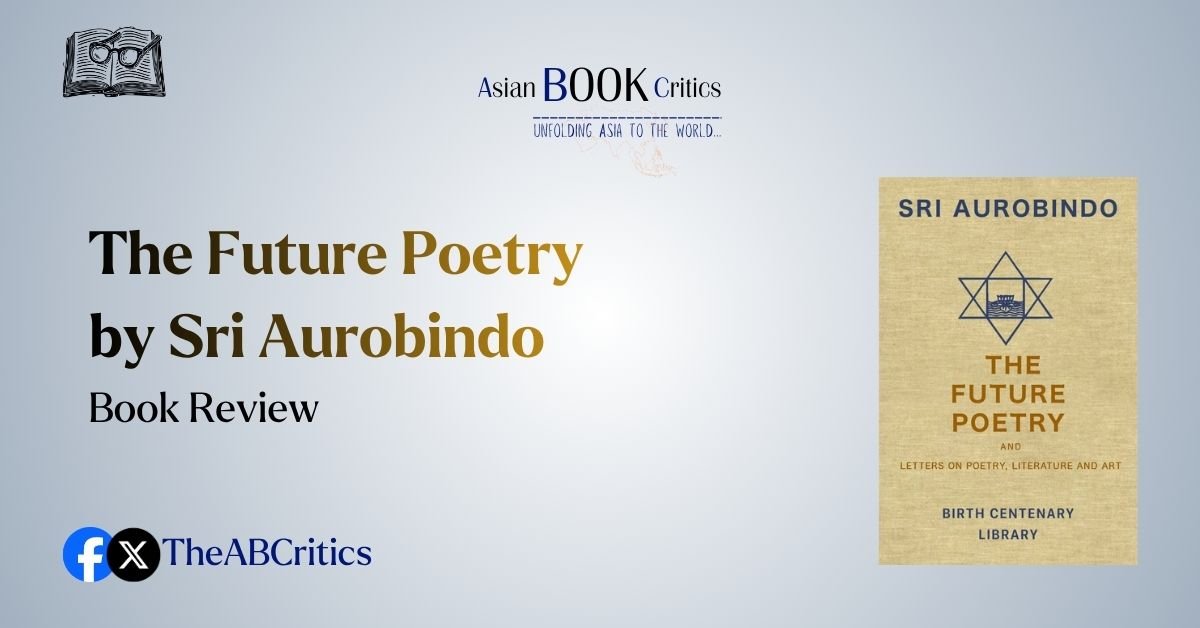
Some books analyse poetry, some chronicle literary movements, and there are books that offer technical observations on metre, diction, and style. However, there are rare works that attempt to redefine the very purpose of poetry in human civilisation. Sri Aurobindo’s The Future Poetry belongs unmistakably to this latter category. First serialised in Arya between 1917 and 1920 and revised over subsequent decades, this monumental work is not merely a treatise on literature. It is a philosophical inquiry into the origins of poetic inspiration, a spiritual exploration of language, and a prophetic vision of the future direction of human creativity. More than a century after its composition, it continues to stand as one of the most original contributions to literary criticism produced anywhere in the world.
To approach The Future Poetry merely as a work of literary criticism would be to misunderstand its ambitions. Sri Aurobindo is not interested in discussing poetry as an aesthetic pastime or a cultural accomplishment. He seeks to uncover its deepest source and highest destiny. The central question that animates the book is ironically ordinary: What is poetry at its most elevated level? In pursuing this question, the poet-seer moves far beyond conventional literary criticism into the realms of philosophy, psychology, spirituality, and cultural evolution. The result is a work that simultaneously examines the history of poetry and predicts its future possibilities. The Future Poetry by Sri Aurobindo becomes a collective voice of the Indian consciousness that appreciates poetry in its most decorated state. This remarkable collection of meditative essays on poetry serves as an intellectual vantage point where spirituality, philosophy, history, and literary criticism converge, yielding some of the most profound observations on the nature of poetry and its future possibilities.
What immediately distinguishes Sri Aurobindo from most Western critics is his refusal to reduce poetry to either technique or imagination. While many influential Western theorists have regarded poetry as imitation, expression, emotional release, or verbal craftsmanship, Sri Aurobindo proposes something radically different. He repeatedly argues that poetry reaches its highest fulfilment only when it becomes a vehicle of spiritual truth. This conviction is perhaps most succinctly expressed in one of the book’s most memorable assertions: “The true creator, the true hearer is the soul.”
This statement alone marks a profound departure from dominant Western critical traditions. Aristotle’s theory of mimesis, Matthew Arnold’s conception of poetry as a substitute for religion, T. S. Eliot’s doctrine of impersonality, and the New Critics’ emphasis on textual autonomy all remain fundamentally concerned with literature as a human artefact. Sri Aurobindo, by contrast, shifts the centre of gravity from the intellect to the soul. Poetry, in his understanding, is not primarily an achievement of linguistic skill. It is an act of revelation. The poet becomes significant not because he possesses technical mastery but because he has gained access to a deeper vision of reality.
This vision-oriented understanding of poetry forms the intellectual backbone of the entire book. Sri Aurobindo emphatically declares that “Vision is the characteristic power of the poet.” The poet, therefore, is fundamentally a seer. This idea recurs throughout the text and reaches one of its most striking formulations when he writes that “He is, as the ancients knew, a seer and not merely a maker of rhymes.” In this single sentence, Sri Aurobindo restores poetry to the exalted position it occupied in the Vedic tradition, where the poet was regarded not merely as an artist but as a discoverer of truth.
The implications of this perspective are immense. If poetry originates in vision, then language becomes secondary to perception. The poet’s primary task is not to arrange words beautifully but to see deeply. Consequently, Sri Aurobindo argues that “The essential power of the poetic word is to make us see, not to make us think or feel.” This statement may initially appear surprising, especially in an age accustomed to associating poetry with emotional expression. Yet it lies at the heart of his theory. Thought and emotion are important, but they are consequences rather than causes. Before poetry can move or persuade, it must reveal. It must illuminate realities hidden beneath the surface of ordinary experience.
The originality of The Future Poetry reaches its highest expression in Sri Aurobindo’s concept of the “Mantra”. No idea in the book is more distinctive or more influential in understanding his aesthetics. For him, the future evolution of poetry depends upon recovering this ancient principle. He defines the Mantra not as a religious formula but as the highest form of poetic utterance. It is a language charged with spiritual force and revelatory power. As he explains, “The Mantra is born through the heart and shaped or massed by the thinking mind.”
This formulation beautifully captures Sri Aurobindo’s attempt to reconcile intuition and intellect. Unlike romantic theories that often privilege emotion at the expense of reason, or modernist theories that elevate intellectual complexity, Sri Aurobindo insists upon a synthesis. The heart receives the truth, the mind gives it form, and poetry becomes the medium through which that truth enters collective consciousness. The poet is neither an emotional enthusiast nor an intellectual technician. He is a mediator between higher realities and human language.
This conception culminates in one of the most significant declarations in the entire book: “Poetry is the Mantra only when it is the voice of the inmost truth.” Here, Sri Aurobindo establishes a criterion for greatness that differs markedly from those proposed by most Western critics. A poem is not great because it is formally innovative, emotionally powerful, politically relevant, or psychologically insightful, though it may possess all these qualities. Its ultimate greatness depends upon the degree to which it embodies truth and reveals it through language.
Such a vision inevitably affects his understanding of poetic form. One of the most fascinating sections of the book concerns rhythm and metre. Modern criticism frequently treats metre as a technical device, but Sri Aurobindo regards it as something far more profound. He argues that great poetry emerges only when multiple elements unite in perfect harmony. As he writes, “All great poetry comes about by a unison of these three elements.” These elements are rhythm, style, and spiritual vision. The statement reveals the holistic nature of his poetics. Rhythm without vision becomes mechanical. Vision without rhythm remains inarticulate. Style without either degenerates into ornamentation. True poetry occurs when all three converge.
His discussions of rhythm are particularly illuminating because they reveal his dissatisfaction with purely formalist approaches. He does not reject technical excellence. Indeed, he repeatedly emphasises its importance. Yet technical perfection alone can never produce greatness. He insists that rhythm must become the audible expression of spiritual movement. What matters is not merely the arrangement of syllables but the manifestation of consciousness through sound. Such observations explain why his criticism continues to feel fresh even in contemporary debates surrounding free verse and experimental poetics.
At this point, it becomes clear why The Future Poetry differs so radically from most works of literary theory. Sri Aurobindo is not interested in describing what poetry has been. He is interested in imagining what it might become. The title itself signals a prophetic orientation. Throughout the work, he examines English poetry from Chaucer to modernity not as a completed tradition but as a developing organism. Each age contributes something valuable, yet none represents the final achievement. Poetry, like humanity itself, remains unfinished.
This evolutionary perspective gives the book an extraordinary intellectual energy. Sri Aurobindo believes that human consciousness is moving towards greater spiritual awareness and that poetry will inevitably participate in this transformation. He therefore predicts the emergence of a new kind of poetic expression capable of articulating deeper truths than those previously accessible. In one of the book’s most revealing passages, he suggests that poetry has occasionally achieved such heights in the past but only in isolated moments. The future, however, may make this achievement more deliberate and sustained.
What is especially remarkable is that this vision is neither narrowly Indian nor exclusively Western. Sri Aurobindo writes from within the Indian intellectual tradition, yet his perspective remains profoundly universal. He engages extensively with English poetry, discusses European literary movements with impressive familiarity, and draws upon both Eastern and Western cultural resources. Rather than opposing the two traditions, he seeks their synthesis. He recognises the strengths of English poetry, particularly its richness of expression and psychological depth, while simultaneously introducing concepts from the Vedas and Upanishads that expand conventional literary discourse.
This intercultural dimension makes The Future Poetry particularly relevant in the twenty-first century. Contemporary discussions about world literature often emphasise plurality, dialogue, and the need to move beyond Eurocentric frameworks. Sri Aurobindo anticipated such conversations decades before they became fashionable. He demonstrated that Indian philosophical traditions could contribute not merely supplementary insights but foundational concepts capable of reshaping literary theory itself.
The intellectual range of the book is astonishing. It moves effortlessly between literary history, aesthetic theory, cultural criticism, spiritual philosophy, and visionary speculation. Yet despite the density of its ideas, it never loses its sense of purpose. Every argument ultimately serves a larger question: how can poetry help humanity realise its highest possibilities? Few critics have approached literature with such seriousness. Fewer still have done so without sacrificing literary sensitivity.
Perhaps the greatest achievement of The Future Poetry lies in its restoration of faith in poetry itself. In an era increasingly dominated by utilitarian values and technological distractions, Sri Aurobindo reminds us that poetry is not a luxury. It is a mode of knowing. It is a means of discovering truths inaccessible to ordinary discourse. It enlarges consciousness and deepens perception. Above all, it reconnects humanity with dimensions of existence that modern life often neglects.
The book concludes with a vision that remains both inspiring and challenging. Sri Aurobindo imagines a future in which poets become instruments of a larger consciousness, revealing truths that transcend cultural and historical limitations. His faith in poetry’s destiny finds expression in a statement that serves as a fitting conclusion to his entire argument: “The poets of whatever tongue and race who most completely see with this vision and speak with the inspiration of its utterance are those who shall be the creators of the poetry of the future.”
That sentence captures the enduring significance of The Future Poetry. It is not merely a study of literature. It is an invitation to reimagine literature’s purpose. Sri Aurobindo asks readers to think beyond technique, beyond schools and movements, beyond the temporary fashions of criticism. He asks them to consider poetry as a path towards truth, beauty, and spiritual awakening. Whether one agrees with every aspect of his vision is ultimately beside the point. The sheer magnitude of his intellectual ambition commands admiration.
More than a century after its first appearance, The Future Poetry remains one of the most profound reflections ever written on the nature and destiny of poetic art. It challenges assumptions, broadens horizons, and restores a sense of wonder to literary criticism. Above all, it reminds us that the greatest poetry does not merely describe the world. It reveals the deeper realities from which the world itself emerges.
Dr Alok Mishra
(Dr Alok is a poet, literary critic, and professor of English Literature at the Nava Nalanda Mahavihara, Nalanda)