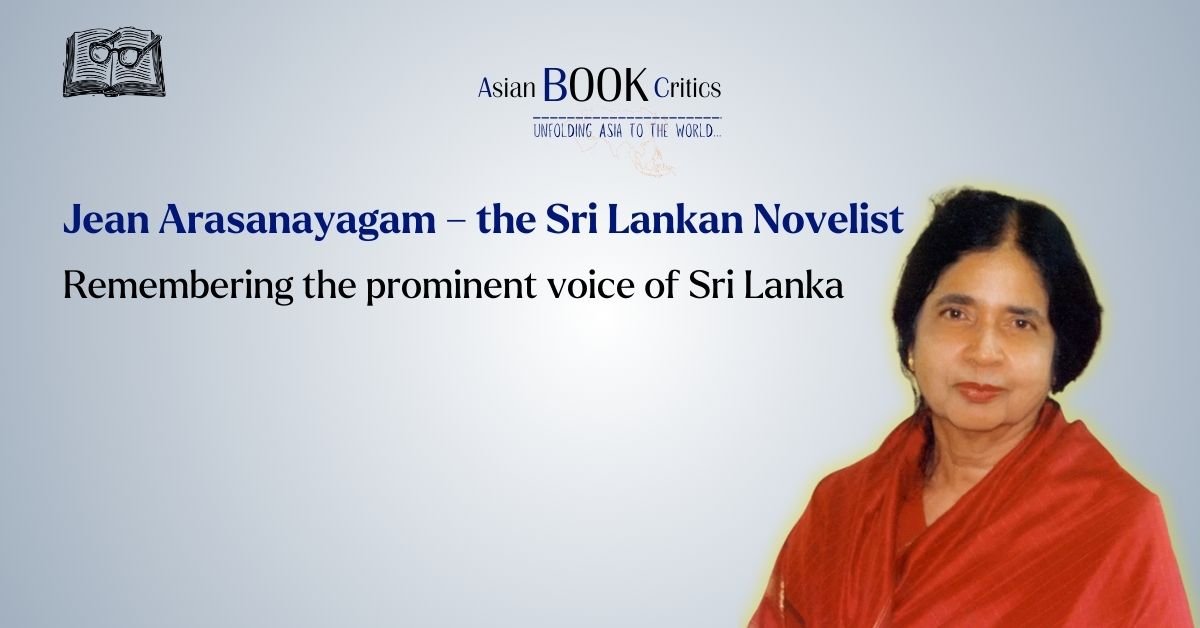
Jean Arasanayagam remains one of the most compelling literary voices to emerge from Sri Lanka in the twentieth century. Her work stands at the problematic intersection of personal memory, ethnic identity, political violence, and the fragile search for belonging in a country marked by decades of conflict. Born in 1931 into a Dutch Burgher family and later married into a Tamil household, she occupied a unique cultural position that allowed her to view Sri Lankan history from multiple vantage points. This dual belonging profoundly influenced her writing. She witnessed the shaping of identity not from a fixed centre but from a shifting liminal space where cultures, languages, and loyalties overlapped in ways both enriching and painful. Her literary journey reflects these complexities with honesty, emotional depth, and a rare intellectual courage.
Arasanayagam wrote poetry, fiction, memoirs, and essays, but she is remembered primarily as a poet who chronicled the inner effects of political trauma. The ethnic conflict in Sri Lanka profoundly altered her life. During the anti-Tamil riots of 1983, her family was directly affected, and she spent time in a refugee camp despite belonging ethnically to the Burgher community. This experience permanently changed her creative vision. She began to write with sharpened urgency about displacement, the fragility of safety, the weight of inherited prejudice, and the helplessness of individuals trapped in violent national narratives. What makes her work unique is that she did not allow this suffering to harden into bitterness. Instead, she used it to interrogate identity, to question divisions, and to explore the inner landscapes of people caught in the crossfire of history.
A powerful autobiographical thread shapes her writing. Yet it never feels self-indulgent. She uses personal memory not to centre herself but to understand the conditions that shape collective experience. This is particularly evident in her collections such as Apocalypse ’83, A Colonial Inheritance, and The Cry of the Kite. Her poems often feel like testimonies spoken in a quiet, steady voice, even when they arise out of chaos. She does not attempt to beautify trauma. Her imagery is often stark, elemental, and direct, but the emotional tone remains reflective rather than accusatory. Readers encounter pain through the clarity of her witnessing, not through rhetorical force.
One of the strengths of Arasanayagam’s writing is the way she brings together anthropology, history, and lyrical intensity. She trained as an anthropologist, and this background appears in the way she observes rituals, customs, familial hierarchies, and cultural behaviour. Her poems often move between personal experience and ethnographic detail, creating a layered narrative that captures both emotion and context. She writes about childhood memories, missionary influence, colonial residues, class structures, and the domestic rhythms of Sri Lankan life. Yet she also writes about fear, exile, loss, and moral injury. Her ability to navigate these shifts makes her work rich in meaning and humane in tone.
Her exploration of identity is particularly striking because she never treats identity as a fixed category. Being a Burgher married to a Tamil, she understood how fragile and negotiable identity becomes during periods of ethnic tension. Her poetry wrestles with questions such as: What does it mean to belong? How do communities define insiders and outsiders? How does marriage transform cultural allegiance? What remains of one’s identity when the nation fractures? These questions appear repeatedly in her writing, but she approaches them with nuance rather than certainty. She neither romanticises multiculturalism nor outright condemns inherited identity. She presents identity as a lived experience that carries both continuity and rupture.
Arasanayagam’s style is shaped by a narrative clarity that avoids unnecessary ornamentation. She prefers clear sentences, grounded imagery, and steady rhythm. Her poems often move through memory as though she is walking through a landscape she knows intimately. Scenes are described with precision: the colours of a room, the sound of the sea, the weight of silence in a camp, the smell of burning. She rarely uses decorative metaphor simply for effect. When a metaphor appears, it arises naturally from the situation and deepens the poem’s emotional resonance. This restraint gives her work a sense of integrity. She never tries to overwhelm the reader with dramatic gestures. Instead, she allows emotional power to accumulate through careful observation and honest reflection.
Her writing also demonstrates a remarkable sense of moral witness. She writes not simply to record events but to confront the ethical questions they raise. What responsibilities do individuals bear during political violence? How do fear and prejudice distort ordinary lives? What does forgiveness mean in the aftermath of destruction? These questions appear throughout her poems, yet she never answers them simply. She acknowledges the complexity of suffering. She refuses to assign guilt to entire communities. She recognises the tragic interconnectedness of victims and perpetrators in a society shaped by deep structural conflict. This moral clarity sets her apart from writers who treat political violence as background scenery. For Arasanayagam, violence is always personal, always relational, always capable of reshaping the psyche.
One of the recurring themes in her work is the idea of home. For Arasanayagam, home is never simply an architectural space. It is the site of belonging, memory, tenderness, and vulnerability. In many of her poems, home becomes a contested space, threatened by violence or shaped by cultural restrictions. The havens of childhood are contrasted with the uncertainty of refugee camps. Domestic rituals become fragile shields against external turmoil. Her exploration of home resonates deeply because it mirrors the experiences of thousands whose lives were disrupted by the civil conflict. Through her poems, home becomes both a refuge and a reminder of what has been lost.
Nature is another crucial dimension of Arasanayagam’s imagery. She writes about landscapes not as decorative backdrops but as psychological extensions of human experience. The sea, rivers, forests, and mountains appear in her poems as carriers of memory. She uses natural imagery to evoke Sri Lanka’s cultural diversity and to contrast the earth’s permanence with the impermanence of human violence. This interplay between nature and conflict creates a complex emotional register. Sometimes nature consoles the suffering individual. Sometimes it sharpens the sense of loss. Sometimes it offers a brief glimpse of transcendence.
Her use of autobiographical detail deserves particular attention. Arasanayagam does not hide behind fictionalised representations. She writes openly about her own displacement, her family’s suffering, her emotional wounds, and her attempts to reconcile conflicting cultural identities. Yet she never reduces her story to personal grievance. Her experiences open into broader reflections on humanity. She transforms private trauma into collective insight. This is why her work resonates even with readers who have not experienced war. She addresses universal questions through the specific lens of Sri Lankan history.
Another notable quality of Arasanayagam’s work is her commitment to truth-telling even when truth hurts. She writes about complicity, guilt, silence, and the moral failure of societies that allow violence to flourish. She does not position herself as a heroic victim. Instead, she acknowledges her own privileges, contradictions, and vulnerabilities. This honesty strengthens her ethical voice. Readers trust her because she does not claim moral superiority. She speaks from the position of someone who has suffered, observed, questioned, and learned to look inward as well as outward.
List of Major Works by Jean Arasanayagam:
Apocalypse ’83 (1984)
Published shortly after the devastating anti-Tamil riots of July 1983 (known as “Black July”), this poetry collection stands as perhaps Jean Arasanayagam’s most potent and widely recognised work. In Apocalypse ’83, she transforms personal trauma and national catastrophe into anguished, urgent poetry that refuses to remain silent. The poems draw on vivid images of violence, destruction, fear, displacement and loss — gutted houses, torn lives, refugees, burning homes, uprooted lives.
What makes this collection special is the way she connects her own experience (as a member of a minority community, a Burgher, married into a Tamil family) to the broader suffering of entire communities. Her identity and marginal belonging become lenses through which she interrogates national identity, ethnic hatred, and the fragility of social harmony. The poems bear witness. They do not write propaganda or grand moralising. Instead, Arasanayagam records the horror and personal grief with disciplined clarity. In doing so, she gives voice to many who suffered but remained unspoken. Apocalypse ’83 remains a vital document — a literary memorial for a tragic moment in Sri Lankan history.
A Colonial Inheritance and Other Poems (1985)
In this collection, Arasanayagam broadens her focus from immediate violence to the deeper layers of historical identity, colonial legacy, and cultural hybridity. Coming just a year after Apocalypse ’83, the book reflects her sustained engagement with what it means to inherit a colonial past, mainly as someone belonging to the “Burgher” community — a group shaped by European descent and colonial complicities.
Her poems in this collection meditate on home, memory, language, belonging, and alienation. She examines how colonial rule, missionary education, ethnic mixing, and subsequent nationalist fervour have complicated the sense of identity for minority communities in Sri Lanka. Rather than offering nostalgic or romanticised reflections, Arasanayagam writes with sobriety and critical empathy. Her tone remains calm but haunted, her images often lyrical, and her voice patiently questioning rather than accusatory. In this way, A Colonial Inheritance explores how personal history becomes entangled with national history and how individuals born into hybrid identities must navigate the tensions among memory, belonging, and loss.
The Cry of the Kite (1984) — short stories + poetry
The Cry of the Kite is a hybrid work that includes short stories (and possibly poems), allowing Arasanayagam to broaden her narrative scope from pure lyric poetry to prose and storytelling. Through this mode, she explores themes of displacement, identity, loss, and cultural tensions in a way that complements her poetry.
In these stories, characters often inhabit the margins — people shaped by changing social conditions, ethnic tensions, migration or loss. Arasanayagam’s prose retains the same clarity as her poetry but adds narrative structure, character psychology, and social observation. The “kite” becomes a metaphor for longing, freedom, and fragility. The work stands as a testament to her versatility as a writer. She is not limited to one genre or mode. Instead, she adapts whichever form best serves the emotional and moral weight of what she wants to say. The Cry of the Kite offers readers an opportunity to witness her as both poet and storyteller — someone capable of holding personal memory, social reality and imaginative empathy together in one frame.
All Is Burning (1995) — Prose / Fiction
By the mid-1990s, Jean Arasanayagam had established herself as a critical voice in poetry. With All Is Burning, she brought her sensibilities into long-form prose fiction, demonstrating her ability to craft narrative beyond the constraints of lyric forms.
The novel addresses issues of violence, identity, uprooting, memory, and social collapse. In the wake of years of conflict, ethnic tension, and national trauma, All Is Burning explores how individuals navigate fear, loss, and displacement. Arasanayagam does not write sensationalist tragedy. Instead, she probes the psychological and moral impact of violence on ordinary lives. The novel gives voice to those who suffer not only from external oppression but from the inner fractures of identity, belonging, and memory. Its power lies in empathy, detail, and refusal to simplify complex social dynamics. For readers interested in understanding the human consequences of political conflict, All Is Burning remains a significant work — one that combines social realism, cultural critique, and emotional depth.
The Life of the Poet (2017)
One of Arasanayagam’s later major works, The Life of the Poet (for which she was honoured with the prestigious literary prize in Sri Lanka in 2017), represents a reflective and mature summation of her life, identity, traumas, memories, and scholarly journey.
In this collection, she blends memoir, poetry, and contemplative prose to examine what it means to live as a hybrid individual — shaped by colonial heritage, minority status, inter-ethnic marriage, and decades of conflict. The work speaks to displacement and belonging, to the long memory of trauma, to reconciliation with loss, and to the fragile hope that survives in human consciousness. Rather than invoking anger or bitterness, the collection seeks healing through remembrance. Her writing here is introspective — she revisits childhood, education, personal relationships, nationhood, and the many folds of identity that shaped her life. The Life of the Poet thus serves as both a self-portrait and a cultural testimony. It offers readers a sincere and humane exploration of one life lived amidst complicated histories, divided loyalties, and the lingering need for belonging and reconciliation.
Why These Works Matter Together
These five works represent key phases in Jean Arasanayagam’s literary and personal journey. From Apocalypse ’83, where shock and political violence forced her to witness and bear testimony through poetry, to A Colonial Inheritance where she explored the roots of identity and history; from The Cry of the Kite where she moved into prose and narrative storytelling, to All Is Burning where fiction gave her room to examine trauma in extended form; culminating in The Life of the Poet, in which memory, reflection, and self-understanding converge.
Taken together, they show how Arasanayagam never stopped evolving. She remained responsive to the changing social realities around her and allowed her writing to shift accordingly. Yet certain constants endure: a commitment to truth-telling, a deep empathy for victims of violence and displacement, a keen awareness of social complexities, and a refusal to reduce identity to simple categories. Her linguistic clarity, her avoidance of melodrama, and her blended identity as Burgher and Tamil by marriage give her a unique vantage — one that allows her to critique social injustice without falling into simplistic binaries.
For anyone seeking to understand Sri Lanka’s modern history, the emotional toll of ethnic conflict, and the complexities of cultural identity, Jean Arasanayagam’s works offer an essential resource. They do not provide easy answers. They refuse closure. But they persistently demand that readers remember, empathise, and reflect. In that refusal to simplify, in that commitment to complexity, lies the enduring power of her literary legacy.
Her later works show an increasing turn toward spiritual introspection. Without escaping the realities of the world, she begins to reflect on endurance, healing, and the possibility of reconciliation. Her poems become spaces where sorrow can be carried without being denied. She explores tenderness, memory, family bonds, and the search for inner peace in the aftermath of collective trauma. This movement from witness to reflection, from conflict to contemplation, is one of the most beautiful aspects of her literary evolution.
The Final Words:
Jean Arasanayagam’s contribution to South Asian literature is significant because she expanded the emotional and thematic possibilities of poetic testimony. She offered an alternative to both political propaganda and sentimental nostalgia. She created a voice that is rooted in personal experience but never confined by it. She demonstrated how poetry can become a method of healing, a form of moral inquiry, and a bridge across divided communities.
For anyone interested in Sri Lankan literature, postcolonial studies, feminist writing, or the relationship between memory and identity, Arasanayagam’s work offers a deep, thoughtful, and compassionate resource. She remains a writer who insisted on honesty, who witnessed her world with clear eyes, and who transformed painful history into language that invites understanding rather than resentment. Her legacy lies not only in her body of work but in the courage with which she confronted the world and the dignity with which she turned suffering into insight.
By Nidhi for Asian Book Critics
__