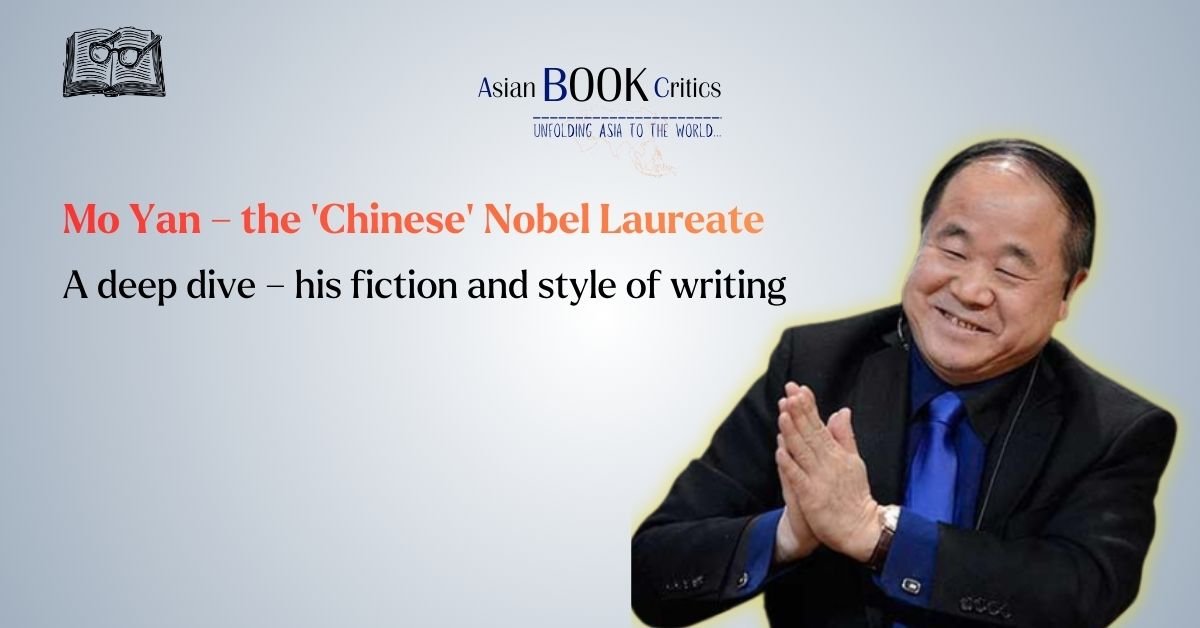
Mo Yan’s fiction has long occupied a distinctive place in contemporary world literature. His books offer readers a visceral, often hallucinatory entry into rural China, where history, myth, and the bodily realities of peasant life converge in scenes that are at once brutal, comic, mythic, and tender. Born Guan Moye in 1955 in Gaomi, a county in Shandong, he adopted the pen name Mo Yan, which means roughly “don’t speak,” and from this paradox—an author whose work insists that certain truths must be told even when speech is perilous—his long career unfolded. He left formal schooling early during the Cultural Revolution, worked in a cottonseed factory, and later joined the People’s Liberation Army, where he began writing short pieces. His rise to international prominence is the story of a writer who transformed local memory and oral traditions into narratives of broad moral reach. Basic facts of his life and the Nobel Committee’s assessment of his art underline how rooted his fiction is in both place and oral heritage.
If one seeks an immediate explanation for Mo Yan’s global readership, several attractions converge. First, his imaginative register is refreshingly hybrid. Critics and scholars frequently describe his mode as a form of Chinese magical realism or hallucinatory realism. This label gestures at affinities with Latin American fabulists while respecting essential differences. Mo Yan’s landscapes are saturated with folk songs, raucous local humour, ritual language, and bodily imagery that transform the everyday into the uncanny. Scenes of harvest, roadside slaughter, birth, and festival blur together with visions that read like mythic hallucinations. That fusion creates a texture that appeals to readers who want literature that is formally inventive while remaining rooted in social specificity. Academic readings of his work emphasise how he reworks oral narrative and local performance modes to create a narrative voice that is both exuberant and earthy.
Information BOX: Mo Yan’s original name is Guan Moye.
Second, Mo Yan writes big, sweeping novels about collective life and history. Books such as Red Sorghum, The Garlic Ballads, Big Breasts and Wide Hips, Life and Death Are Wearing Me Out, and Frog do more than chronicle individual fates. They track social transformations over decades, showing how political campaigns, famine, war, land reform, and market forces embed themselves in the bones of rural communities. In Life and Death Are Wearing Me Out, for example, the protagonist’s repeated reincarnations serve as a formal device to narrate China’s tumultuous second half of the twentieth century from multiple vantage points. That capaciousness makes Mo Yan’s books attractive to readers who want both narrative sweep and moral complexity. They read his novels as ethnographies, as mythic sagas, and as moral dramas. Scholars note that Mo Yan’s work repackages local memory and ritual into epic narrative forms that feel international while remaining recognisably Chinese.
Third, Mo Yan writes in a language of the senses. His prose explodes with images of food, smell, taste, blood, and soil. The sorghum fields in Red Sorghum are not simply background scenery. They operate as characters. The smell of grain, the taste of wine, and the grit of threshing become vehicles of memory and identity. This sensory intensity contributes to the success of cinematic adaptations and to global interest. Zhang Yimou’s award-winning film Red Sorghum introduced Mo Yan’s story to an international audience in the late 1980s, confirming that the novelist’s visual imagination translates powerfully to the screen. The mixture of the epic and the intimate, the large scale of history, and the microscopic attention to bodies and gestures is a primary reason readers across cultures find his fiction gripping.
A fourth reason Mo Yan attracts readers worldwide is his tonal complexity. He deploys humour and grotesque laughter alongside scenes of violence and despair. The comedy can be ribald and vulgar, the satire sharp, yet underlying both is a humanism that refuses to reduce characters to types. Even when he depicts cruelty, he often does so with an eye to the social conditions that produce it: hunger, humiliation, failed policies, and desperate survival. Readers respond to this ethical complexity. The novels rarely offer simple moral lessons. They complicate pity and anger in ways that make moral judgment difficult and therefore more interesting. Critics have argued that his moral ambiguity is a strength because it forces readers to think rather than accept easy readings. Academic studies of his work show consistent interest in how Mo Yan resists prior norms of socialist realist catechism by returning to the messy, contradictory realities of lived experience.
Mo Yan’s international reputation was solidified by the Nobel Prize in Literature in 2012. The Swedish Academy justified the award by praising his ability to merge folk tales, history, and the hallucinatory into a singular imaginative language. The committee highlighted his “hallucinatory realism” and how this mode enables him to depict the conditions of rural life with mythic force and ethical urgency. That rationale captures both the literary qualities that make him distinctive and the strategic reasons the Academy valued his work at that historical moment: his fiction is formally inventive, intellectually provocative. It offers new ways of narrating twentieth-century China. The Nobel citation emphasised a voice that is both local and global, capable of transforming provincial legend into literature with world significance.
Yet Mo Yan’s position in the global literary field has never been uncontroversial. Some critics in the West and at home questioned whether his perceived closeness to state institutions undercut his moral authority. He served as vice chairman of the state-sanctioned China Writers Association. He accepted official honours and positions, which led to criticism that he had not been sufficiently outspoken about censorship or political repression. Others defended him, arguing that judging his work by his public affiliations misunderstands what his fiction attempts to do: represent the accumulation of social memory in a country where overt political critique has sometimes been dangerous. The debate intensified around broader questions regarding the responsibilities of writers under authoritarian regimes. Some critics asked whether a writer who does not openly oppose state violence should be honoured internationally. Many defenders pointed out that Mo Yan’s novels themselves often contain searing accounts of official brutality, bureaucratic idiocy, and the suffering produced by policy. The debate remains unresolved, but it reinforced the idea that Mo Yan’s stature is not merely aesthetic. It is entwined with political symbolism.
The controversies surrounding his Nobel, however, did not erase the reasons readers loved his books. Translators such as Howard Goldblatt played a crucial role in rendering Mo Yan’s distinctive voice into English and thereby facilitating his international readership. Subtle problems remain in translation for any author who traffics in dialect, oral performance, and culturally heavy allusions, but the energetic cadence of Mo Yan’s sentences often survives. Translators have had to find ways to convey bawdy jokes, folk songs, regional idioms, and grotesque metaphors. Where they succeed, the books read as though they were both foreign and intimately accessible, a combination that entices readers. The practical fact of good translation, combined with global interest in China’s history, meant that Mo Yan’s books reached audiences seeking to understand China through narratives that avoided complacent teleology.
Mo Yan’s appeal also owes much to his ability to fuse formal experimentation with storytelling that remains deeply human. Consider Big Breasts and Wide Hips, a sprawling family epic that telescopes Chinese history into the life of a matriarch and her progeny. Consider Frog, which interrogates China’s one-child policy through the voice of an abortion doctor now under moral scrutiny. In each case, the narrator’s voice is vital. Even when the narrator is unreliable, the voice carries an authority of witness. That authority is not the same as moral certainty. It is the authority of someone who has lived through a catastrophe and tells the story with an eye for the comic and the tragic. The books prompt readers to ask hard questions about complicity, survival, and the moral fractures of history. They make us hold atrocity and human frailty in the same glance. That capacity to make ethical thinking visceral is one of Mo Yan’s most outstanding achievements.
At the same time, intellectual defenders of Mo Yan have argued that the Nobel recognition was partly an acknowledgement of Chinese literature’s increasingly porous relationship with world literature. Awarding the prize to a mainland Chinese citizen who continued to work in China after the Cultural Revolution was also a symbolic gesture. It recognised a literary formation that emerged from within structures of state power and popular oral cultures rather than from exile or dissidence alone. Some academics have read the Nobel as the Swedish Academy’s endorsement of a pluralist view of Chinese letters. It suggested that literary achievement need not always take the form of overt political opposition. Others read the prize as part of the Academy’s broader willingness to reward narrative experimentation and story worlds that combine myth with social investigation. Both readings highlight that Mo Yan’s global standing results from aesthetic merit and geopolitical signalling.
Mo Yan’s worldwide readership has also been nourished by film and cultural adaptation. Zhang Yimou’s film Red Sorghum, which adapts parts of Mo Yan’s early saga, won the Golden Bear at the Berlin Film Festival and introduced international audiences to the visceral world Mo Yan writes about. Film, translation, festival circuits, and academic attention have together built a cultural infrastructure that made his novels available to critics, filmmakers, and scholars. That cultural visibility ensured that debates about his politics reached broader publics and that his books remained topics of conversation across continents.
Finally, one must not underestimate the elemental pleasure of Mo Yan’s sentences. Readers who praise his work often emphasise the sheer imaginative joy of his storytelling. There is a comic energy in his grotesque images, a tenderness toward flawed villagers, and a relentless curiosity about how ordinary people make sense of the world. Even when his novels indict institutions, they remain faithful to the humanity of their characters. This is why, despite controversy, many readers continue to return to his books. They want immersion in a world where the harvest is haunted, where history is a bodily force, where laughter and suffering live cheek by jowl, and where language can make both the beautiful and the unspeakable visible.
Below is a set of major novels by Mo Yan, each accompanied by a brief critical summary of about 100 words.
Red Sorghum (1986)
Red Sorghum is the novel that brought Mo Yan global attention, a multigenerational saga set in Gaomi Township. Its visceral imagery, shifting timelines, and blend of folklore and violence create a narrative that feels both mythic and brutally historical. The story traces resistance against Japanese occupation while exposing the inner dynamics of rural life marked by desire, betrayal, and endurance. The sorghum fields themselves become symbols of fertility, death, and cyclical renewal. The novel’s power lies in its fusion of family memory with national trauma, using sensory intensity and lyrical brutality to redefine how twentieth-century Chinese history can be narrated.
The Garlic Ballads (1988)
Based on the real-life Garlic Crisis in Shandong, The Garlic Ballads exposes the catastrophic consequences of bureaucratic indifference and rural desperation. Mo Yan follows farmers whose crop glut and government mismanagement push them into open rebellion. The novel moves between ballad-like storytelling, lyrical interludes, and stark political critique. Its emotional core lies in the way ordinary individuals are crushed by systems far beyond their control. Through alternating perspectives, Mo Yan reveals how love, loyalty, and dignity struggle for survival under corrupt authority. The narrative’s blend of music, tragedy, and documentary style gives it unusual resonance and moral force.
The Republic of Wine (1992)
A daring work of metafiction, The Republic of Wine explores corruption, appetite, and the grotesque through an experimental narrative that alternates between detective fiction, letters, and self-referential encounters. The story investigates rumours of cannibalistic feasts in a fictional province, exposing the moral collapse of a society driven by greed and indulgence. Mo Yan uses excess, satire, and surreal imagery to critique the darker corners of contemporary Chinese life. The novel’s brilliance lies in its refusal of fixed meaning; it forces readers to confront the uneasy overlap between fiction and truth, and between state mythmaking and private depravity.
Big Breasts and Wide Hips (1996)
One of Mo Yan’s most ambitious epics, Big Breasts and Wide Hips centres on the life of Shangguan Lushi, a matriarch whose body and endurance become metaphors for twentieth-century China. Through her and her many children, Mo Yan narrates decades of political upheaval, famine, war, and social transition. The novel has been widely discussed for its treatment of femininity, motherhood, and the female body as national allegory. Its scale is immense, yet its emotional grounding remains intimate. Mo Yan’s blend of myth, humour, tragedy, and vivid rural detail produces a narrative where historical trauma intersects with domestic resilience.
Sandalwood Death (2001)
Set during the Boxer Rebellion, Sandalwood Death reconstructs a world in which imperial power, local politics, and theatrical performance intersect. Written in a hybrid idiom inspired by traditional opera, the novel is highly rhythmic and formally innovative. It follows an executioner and the complex moral entanglements surrounding a condemned rebel leader. Mo Yan uses the ritual of execution—especially the sandalwood torture—as a central metaphor for cruelty embedded within political and cultural systems. The narrative moves between brutality and aesthetic beauty, revealing how violence is staged, justified, and internalised. The novel’s stylistic daring makes it one of Mo Yan’s most challenging works.
Life and Death Are Wearing Me Out (2006)
Often regarded as Mo Yan’s masterpiece, this novel opens with the execution of a landowner who is repeatedly reincarnated as various animals. Through these shifting forms, the story travels across decades of revolutionary and post-revolutionary China. The reincarnation device allows Mo Yan to narrate history from multiple vantage points, offering satire, empathy, and philosophical inquiry. The novel examines class struggle, political zealotry, and the absurdities of social transformation. Its humour is sharp, its emotional register surprisingly tender, and its metafictional elements thoughtfully deployed. The book’s imaginative boldness and structural playfulness explain much of Mo Yan’s international acclaim.
Frog (2009)
Frog confronts the human toll of China’s one-child policy through the confessional narrative of a playwright whose aunt, a midwife and loyal agent of state policy, becomes the embodiment of its moral contradictions. Mo Yan structures the novel through letters, eyewitness accounts, and theatrical framing, allowing multiple perspectives to shape the narrative. The book addresses reproductive violence, guilt, and the psychological afterlife of political coercion. It avoids didacticism, instead offering a complex portrait of individuals shaped by ideology and fear. The novel’s blend of documentary realism and symbolic imagery makes it a powerful exploration of state power and personal conscience.
In sum, Mo Yan’s global appeal arises from an intricate mixture of factors. His narratives are formally adventurous yet emotionally accessible. They incorporate local oral traditions and folk idioms into world literature. They offer sweeping historical panoramas anchored in sensory detail and bodily intensity. They pose ethical questions without providing easy answers and have been made available through committed translators and filmmakers. The Nobel Prize in 2012 recognised these qualities by honouring a writer who fuses folk tale and hallucinatory vision to illuminate the human cost of history. If debates about his political stance persist, they reflect the larger, unavoidable truth that literary value and political context are often inseparable. For the discerning reader, Mo Yan’s fiction remains an invitation to grapple with that discomfort, to read closely, and to listen to stories that complicate rather than console.
By Amit for Asian Book Critics
__
Thanks for reading!
..