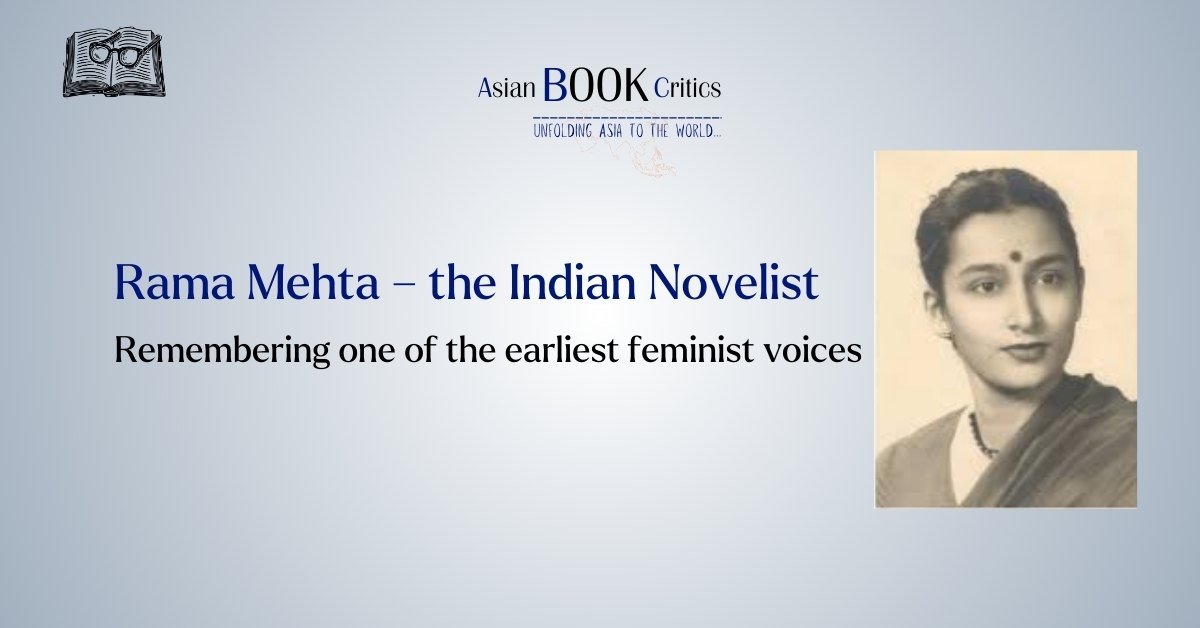
Rama Mehta occupies a distinctive place among Indian women writing in English, not simply because she won the Sahitya Akademi Award for Inside the Haveli, but because she brought the discipline of a trained sociologist to the craft of fiction. Born in 1923 and educated in India and at Columbia University, Mehta worked as a lecturer and sociologist, and was among the first women to join the Indian Foreign Service before resigning after marriage.
Her personal and professional life placed her exactly at the fault line between a traditional, upper-caste social world and the new opportunities of post-independence India. That vantage point shaped her writing. She understood both the security and the suffocation of conservative households, as well as the promise and the loneliness of modern education. Her fiction, criticism, and sociological studies return again and again to this tension, but without bitterness. She observes, records, and gently questions, and through that method, she created a mode of criticism that seeks healing rather than merely exposing wounds.
Before Inside the Haveli, Mehta had already developed a clear thematic interest in childhood, education, and the formation of social attitudes. Her novels Ramu, A Story of India (1966), and The Life of Keshaw (1969) focus on young boys and emphasise the importance of schooling and moral responsibility. Parallel to this fictional work, she wrote sociological studies such as The Western Educated Hindu Woman (1970) and The Hindu Divorced Woman (1975), where she examined the predicament of women caught between an English-medium, modern education and deeply traditional family structures.
These non-fiction works reveal her method. She did not condemn tradition outright, but she traced the psychological and social costs of rapid change, especially for women whose mothers had grown up under purdah and strict ritual expectations. When she turned fully to fiction with Inside the Haveli (1977), she brought this sociological clarity and empirical patience into a narrative form that allowed for greater emotional resonance.
Her writing skills are most evident in the way she controls point of view and atmosphere. Inside the Haveli is written in a deceptively simple, transparent English, but the simplicity is deliberate. The language never overwhelms the world it describes. Instead, it allows the reader to enter the haveli of a former princely Rajput family in Udaipur and observe its customs as if one were moving quietly through its courtyards and corridors. The third-person narrative remains close to Geeta, the educated, Bombay-bred protagonist who marries Govind, the household’s son, and finds herself transplanted into a rigidly traditional environment.
Mehta’s descriptive skill lies in her attention to routine: the sequence of rituals, the timing of meals, the hierarchies among women, the rules of purdah, the expectations surrounding widows and young brides. These details are never presented as an ethnographic spectacle. They are woven into the plot so that readers understand how habit becomes destiny for the women inside the haveli.
The social reflection in Inside the Haveli is layered and patient. At the surface level, the novel presents a household where patriarchy is firmly entrenched. Men occupy the outer world of business and politics. Women belong in the inner quarters, their movements regulated, their dress and speech controlled. Academic discussions have pointed out the novel’s portrayal of female servitude, the purdah system, and the conservative attitudes toward widowhood and female education.
Yet Mehta refuses to caricature this world. She registers the affection, solidarity, and pride that also exist within the haveli. Older women like Bhabhisa and the servants have their own forms of agency, even if they express them through obedience and the defence of custom. It would have been easy to depict the haveli as a purely oppressive institution. Still, Mehta is more interested in showing how women internalise their values and, sometimes, participate in their own subordination.
Geeta’s journey serves as the central thread of Mehta’s critique. Initially, Geeta experiences the haveli as a form of confinement and almost physical suffocation; she struggles with the purdah rules, early rising, constant surveillance, and the expectation that she renounce the informality and independence of her Bombay youth.
As the novel progresses, however, she undergoes what several critics have described as an “inner journey” or “silent transformation.”
She does not stage a dramatic rebellion. Instead, she gradually accepts the emotional ties that bind her to the household, especially after motherhood, and simultaneously begins to introduce small but significant changes. She resumes her own studies, encourages the education of the haveli girls and servant children, starts informal literacy classes, and gently questions superstitions and rigid ritual practices. These actions may seem modest, but within the scale of the novel, they represent a quiet restructuring of the inner world. Geeta’s work suggests that transformation can emerge from within tradition, not only against it.
This is where Mehta’s style of criticism differs from more confrontational feminist fiction. She does not write a novel of open revolt; she writes a story of negotiation. As some recent readings emphasise, Mehta conveys the idea that a woman need not always rebel publicly to preserve her identity. Geeta does not insult her relationships, nor does she reject the haveli itself. She maintains dignity and affection, yet she refuses to surrender her sense of self, carving out an identity that allows her to be both a daughter-in-law of the haveli and a modern, educated woman.
The criticism embedded in the novel is therefore constructive in a productive sense; it works within the constraints of social reality. Mehta shows how structures can be bent, reinterpreted, or quietly expanded, rather than imagining a complete break that was, for most women of that generation, unrealistic.
Her criticism is also balanced by empathy. Mehta’s sociological training makes her alert to the broader historical processes at work. Inside the Haveli is set in a post-independence India where princely states have lost political power but retain social prestige, and where urbanisation and English education are beginning to reshape aspirations.
The haveli represents tradition, but it is a tradition already under pressure from the outside world. Geeta embodies the new middle-class, educated woman. Mehta does not celebrate one and condemn the other; she stages a conversation between them. The novel suggests that modernity without roots can be shallow, but tradition without adaptation can become cruel. This refusal to idealise either pole is one of her finest achievements. It allows her to criticise patriarchal norms without turning the haveli into a mere symbol of backwardness.
If one looks at her essays alongside the novel, the consistency of this stance becomes clearer. In The Western Educated Hindu Woman, Mehta wrote about young women in the 1940s and 1950s who were proficient in English and university educated, but who returned to homes where their mothers spoke no English and remained entirely within the orbit of ritual Hindu domesticity. This unique blend of Hindu culture and English literature, along with the implicit conflict that runs throughout her career, adds a peculiar dimension to the Indian literary horizon.
She notes the psychological stress of moving between these worlds, yet she does not treat the older generation with contempt. Instead, she traces the processes by which values are negotiated, compromised, and sometimes quietly abandoned. The same spirit infuses Inside the Haveli. The fictional Geeta can be read as a narrative embodiment of the sociological figures Mehta studied: women who must invent a modern identity in spaces that lack a vocabulary for it.
Rama Mehta’s prose style serves this project of constructive criticism. She avoids polemical passages. Her sentences are clear, direct, and lean, leaving readers space to form their own conclusions. The emotional intensity is conveyed through the situation rather than authorial commentary. When Geeta feels imprisoned by purdah, Mehta does not deliver a lengthy denunciation of the system; she simply shows the daily rituals, the screens, the restrictions, and the moments when Geeta yearns to step outside. When minor reforms begin to take root, the narrative records them almost casually, reflecting the way real social change often begins unnoticed. This stylistic restraint gives the novel durability. It can be read as a feminist text, a sociological case study of a society in transition, or simply as the story of a young woman finding her place in an unfamiliar world.
Mehta died in 1978, just a year after Inside the Haveli was published, and did not live to see the full recognition the novel received, including the Sahitya Akademi Award in 1979 and its continued presence in syllabi and critical discussions.
In later years, her name has been kept alive not only through the novel but also through initiatives like the Rama Mehta Writing Grant, which supports women writers and reflects her belief in the importance of female voices in public life.
Within the broader tradition of Indian women’s writing in English, she occupies a somewhat quiet, almost understated position, yet her contribution is crucial. She showed that fiction could interrogate social norms without contempt, and that women’s emancipation could be imagined through adjustment and inner strength as much as through dramatic revolt.
To read Rama Mehta today is to encounter a writer who refused both nostalgia and easy iconoclasm. Her fiction acknowledges the beauty of inherited ways of life while gently exposing their injustices. Her sociological insight allowed her to see the haveli not only as a prison for women but also as a complex social organism that had provided identity and security for generations. By placing an educated, modern woman at the heart of that world and showing her gradual transformation from bewildered outsider to reforming insider, Mehta crafted a narrative of change that remains relevant in any society negotiating tradition and modernity. Her writing reminds us that criticism need not be noisy to be effective and that some of the most enduring social questions are best explored through the quiet movements of a single life.
Written by Nidhi for Asian Book Critics
(Thanks for reading!)
Please share your thoughts in the comments.
__