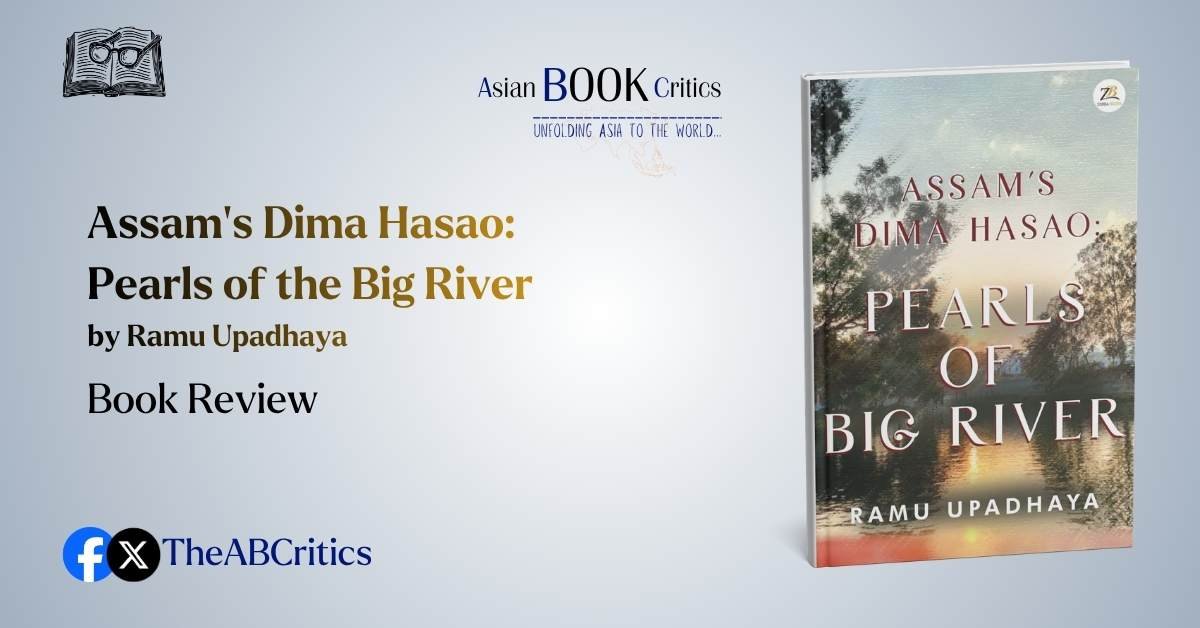
Remembering the Hills Before They Fade: A Critical Review of Pearls of Big River: Assam’s Dima Hasao
In a country as culturally layered as India, it is surprising how many of its stories continue to remain untold. Our libraries are filled with books on empires, freedom movements, metropolitan politics and celebrated national figures, yet the histories of smaller regions often survive only through fading memories and scattered oral traditions. The farther one travels from the country’s intellectual centres, the thinner the written record appears to become. This is particularly true of Northeast India, whose complex social history and cultural diversity have frequently occupied only the margins of mainstream historical writing. Dima Hasao, formerly known as the North Cachar Hills, is one such place. Nestled amidst the scenic hills of Assam, the district possesses a rich legacy of political movements, educational reform, multicultural coexistence and ecological splendour, but surprisingly little of it has entered the national literary consciousness. It is within this silence that Ramu Upadhaya’s Pearls of Big River: Assam’s Dima Hasao finds its purpose. Published by Zorba Books, the volume is not an academic history, nor does it aspire to be a conventional travel narrative. Instead, it is a deeply personal chronicle written by someone who has spent a lifetime observing, recording and reflecting upon the land that shaped him. The book derives its strength precisely from its refusal to chase fashionable literary trends. It remains rooted in its landscape, unapologetically regional and emotionally invested in preserving a world that modern India often overlooks. Reading it, one gradually realises that this is not simply a book about Dima Hasao. It is a quiet argument for why every region deserves someone willing to remember it before memory itself begins to disappear.
That sense of remembrance forms the emotional backbone of the entire work. At its heart, Pearls of Big River is less a historical compilation than an act of cultural preservation. Upadhaya writes with an awareness that history can vanish as easily as forests disappear or old neighbourhoods give way to concrete settlements. Throughout the book, one repeatedly encounters his anxiety that many of the individuals who laid the foundations of modern Dima Hasao have already begun to fade from public consciousness. The title itself is symbolic. The “pearls” are not precious stones but people, each representing an individual contribution to the district’s collective life. Politicians, teachers, administrators, reformers, artisans, social workers and ordinary citizens appear side by side, suggesting that history belongs as much to the anonymous builder as to the celebrated leader. In the moving preface, Whisper of Heart, Upadhaya admits that he feels fortunate to have been born in a place where “some idealists and humanists… went into oblivion instead of being in the limelight,” before dedicating the book to those forgotten lives. That confession transforms the reader’s understanding of everything that follows. The biographies are no longer isolated profiles but acts of gratitude. The district’s name itself becomes part of this larger exercise in remembrance. By tracing the meaning of “Dima Hasao” to the Dimasa language, where “Dima” denotes a “Big River” and “Hasao” signifies a dwelling place, the author subtly turns the book into a metaphorical home for memories that might otherwise have been lost. One of the most admirable qualities of the work is that it resists reducing history to political milestones alone. Alongside eminent figures such as Joy Bhadra Hagjer and Sonaram Thaosen stand educators who established schools under difficult circumstances, community elders who preserved traditions, women who expanded opportunities for future generations, and countless local contributors whose names rarely appear in official records. In doing so, Upadhaya reminds us that communities are not built solely through legislation or political speeches. They are sustained through countless acts of everyday dedication that deserve preservation just as much as landmark historical events.
The sincerity with which these stories are told becomes far easier to appreciate once one understands the man behind them. Ramu Upadhaya is not an academic researcher who arrived in Dima Hasao with notebooks and questionnaires, nor is he a traveller captivated by the novelty of an unfamiliar landscape. He is, in every meaningful sense, a son of the hills he describes. Born in Bhanjang near Haflong, he grew up amidst the district’s changing social and political landscape, witnessing both its moments of optimism and its periods of uncertainty. His father, Late Pitambar Upadhaya, was remembered not merely as a priest but as a progressive community educator whose influence shaped the author’s understanding of public service. Those early experiences remain deeply woven into the narrative. Childhood memories of walking along unpaved roads, attending the District Council Colony Lower Primary School, playing with friends and observing the everyday rhythms of Haflong return repeatedly, giving the book an intimacy that no external historian could easily reproduce. Yet what deserves even greater appreciation is the remarkable consistency of Upadhaya’s commitment to documenting Dima Hasao over several decades. As a journalist, regional chronicler and public intellectual, he has devoted much of his literary life to recording the people, institutions and events that shaped the district’s identity. In an age when many writers seek broader markets by abandoning local subjects for nationally fashionable themes, Upadhaya has moved in precisely the opposite direction. He has remained steadfastly committed to writing about his own region, not because it offers commercial rewards but because he believes its stories matter. That unwavering loyalty gives Pearls of Big River its moral authority. One senses throughout the book that the author is not writing to secure literary recognition. He is writing because he fears that if he does not, no one else will. Such dedication deserves genuine admiration. Regional histories are rarely profitable; they demand years of painstaking documentation, and they often attract only modest readerships. Yet without writers like Upadhaya, countless local histories would quietly disappear. In many ways, his greatest achievement may not simply be this book itself, but his lifelong refusal to allow Dima Hasao to slip into historical anonymity. That persistence transforms him from an author into something rarer: a custodian of collective memory.
What ultimately makes Pearls of Big River rewarding is not simply the information it contains but the distinctive experience of reading it. The book refuses to remain within the boundaries of a single genre. At one moment it reads like an affectionate memoir filled with childhood recollections; in the next it assumes the tone of a historical archive, only to move effortlessly into political commentary, philosophical reflection or a practical blueprint for the district’s future. Readers accustomed to neatly structured historical narratives may initially find these transitions unexpected, yet they gradually reveal something important about the author’s personality. Upadhaya appears incapable of separating memory from history or emotion from public life. For him, they naturally belong together. This gives the narrative a refreshing authenticity. His prose frequently possesses an unpolished earnestness that feels disarmingly honest. There are passages where he recalls the lush orchards of his childhood with almost poetic tenderness, and others where he interrupts historical discussion to express concern about ethical decline, environmental degradation or administrative complacency. Occasionally he coins unusual metaphors that require careful reading, while at other times he allows personal conviction to overshadow literary elegance. These imperfections are real. The narrative sometimes moves abruptly from nostalgic reminiscence to dense administrative discussion, and certain chapters could certainly have benefited from tighter editing and smoother transitions. His preference for elaborate vocabulary and bureaucratic phrasing occasionally slows the pace, demanding patience from the reader. Yet strangely, these very imperfections contribute to the book’s character. They remind us that we are not reading a polished commercial publication produced to satisfy market expectations. We are reading the accumulated reflections of someone who has spent decades carrying the history of his homeland within him. The result is occasionally uneven, but it is never insincere. In an era when polished narratives are often manufactured to appear emotionally authentic, Upadhaya offers something increasingly uncommon: genuine conviction. That authenticity, more than stylistic perfection, becomes the book’s defining literary achievement.
The deeper one travels into Pearls of Big River, the clearer it becomes that the book is animated by ideas far larger than the lives of the individuals it commemorates. Every biography, anecdote and historical episode ultimately points towards a broader vision of what Dima Hasao has represented through much of its history. One of the most striking of these ideas is the author’s unwavering faith in multicultural coexistence. Rather than presenting the district as a collection of isolated ethnic communities, Upadhaya repeatedly portrays it as a shared civic space where the Dimasa, Hmar, Karbi, Zeme Naga, Kuki, Gorkha, Bengali and several other communities gradually learned to build institutions together while retaining their individual cultural identities. At a time when discussions of identity often become exercises in exclusion, the book offers a refreshingly different perspective. Diversity is not treated as a challenge to overcome but as the district’s greatest strength. Equally significant is the importance the author assigns to education. School buildings, teachers and colleges recur throughout the narrative with remarkable consistency, not because they are incidental details but because they represent the foundations upon which every enduring society must rest. Upadhaya clearly believes that roads, markets and administrative reforms have little meaning unless accompanied by educational advancement and moral leadership. His admiration for those who struggled to establish schools under difficult circumstances is among the most moving aspects of the book. Running parallel to this faith in education is another recurring concern: the preservation of nature. The forests, rivers, hills and valleys of Dima Hasao are described with an affection that borders on reverence. Yet these lyrical descriptions are repeatedly interrupted by anxiety over unchecked urbanisation, environmental degradation and poorly planned development. The author’s concern never feels abstract or ideological because it emerges from someone who has watched these landscapes transform across decades. His reflections on ecological stewardship therefore acquire unusual emotional force. The same moral urgency shapes his observations on politics. The biographies frequently contrast the integrity, sacrifice and public-mindedness of earlier generations with what the author perceives as increasing opportunism within contemporary public life. Whether one agrees with this assessment or not, the sincerity behind it is unmistakable. By the time one reaches the closing chapters, it becomes evident that Pearls of Big River is not merely preserving the past. It is also quietly asking what kind of future Dima Hasao wishes to build. In that sense, the book is as much about civic responsibility as it is about history.
No serious review, however, should conclude without acknowledging the book’s limitations, for they are as much a part of its identity as its strengths. The first challenge lies in its organisation. Upadhaya often writes as memories arrive rather than according to a strictly controlled narrative architecture. As a result, the reader occasionally moves abruptly from childhood reminiscences to administrative discussions, from intimate family memories to lengthy policy recommendations, and from lyrical descriptions of Haflong’s natural beauty to detailed institutional histories. These shifts are not impossible to follow, but they can interrupt the rhythm of reading. A more rigorous editorial framework might have grouped related material more cohesively and created smoother transitions between chapters. The language presents another challenge. Upadhaya frequently favours long, elaborate sentences and a vocabulary influenced by administrative and official discourse. While this lends the work a certain individuality, it occasionally obscures ideas that might otherwise have been communicated more directly. There are moments when a simpler sentence would have carried greater emotional weight than an elaborate construction. Likewise, readers seeking a detached historical analysis may occasionally find the author’s admiration for several personalities somewhat uncritical. His desire to honour the region’s pioneers is entirely understandable and often deeply moving, yet some biographies leave little room for complexity or contradiction. Great public figures, after all, are rarely without limitations, and a more balanced engagement with their decisions would have added another layer of historical richness. Yet it would be unfair to judge the book solely through the expectations we bring to conventional academic history. Upadhaya is writing not as a professional historian striving for absolute detachment but as a participant in the history he records. His emotional proximity inevitably shapes his narrative. Rather than diminishing the book, this perspective gives it a distinctive voice. The imperfections remain visible, but they also remind us that this is a deeply personal labour of affection rather than a meticulously engineered scholarly monograph. Ironically, excessive editorial intervention might have removed some of the very spontaneity that allows the author’s personality to emerge so vividly. The book therefore asks its readers to accept a certain amount of structural unevenness in exchange for emotional authenticity. For many, that is a worthwhile exchange.
By the time one turns the final page of Pearls of Big River: Assam’s Dima Hasao, the lingering impression is not of having completed another regional history but of having spent time in the company of someone determined to ensure that his homeland is neither forgotten nor misunderstood. Books such as this remind us that the making of history is not confined to capitals, parliaments or celebrated universities. It also takes place in remote schools established through community effort, in district councils shaped by visionary local leadership, in villages where traditions continue quietly across generations, and in landscapes whose rivers and forests become inseparable from the identities of those who inhabit them. Ramu Upadhaya understands this instinctively, and it is this understanding that gives the book its lasting significance. Even readers with little prior knowledge of Dima Hasao will find themselves appreciating the universal questions that underlie the narrative: How does a community remember its builders? What happens when local histories disappear? Who preserves the stories that never enter national textbooks? These questions extend far beyond the borders of Assam. They concern every society struggling to preserve its cultural memory in an age increasingly shaped by rapid urbanisation, digital distraction and historical amnesia. If the book occasionally lacks the polish of more professionally edited publications, it compensates through an honesty that cannot easily be manufactured. One never doubts the author’s commitment, his affection for the people he writes about, or his desire to leave behind a meaningful record for future generations. In many respects, that sincerity becomes the book’s greatest literary quality. Pearls of Big River may not conform to conventional expectations of historical writing, but neither does it seek to. It occupies a space somewhere between memoir, biography, documentary, civic reflection and cultural testimony, drawing strength from each without being confined by any. Ultimately, the book succeeds because it persuades us that regional histories are never merely regional. They illuminate the larger story of a nation through the lives of ordinary people whose contributions seldom receive national recognition. In preserving the memory of Dima Hasao with patience, affection and unwavering conviction, Ramu Upadhaya has produced far more than a chronicle of one district. He has offered a moving reminder that the truest measure of a civilisation lies not only in the histories it celebrates, but also in the histories it chooses not to forget.
Get a copy from Amazon India – click here to buy now.
Review by Amit for Asian Book Critics