Part I: Between Philosophy and Poetry
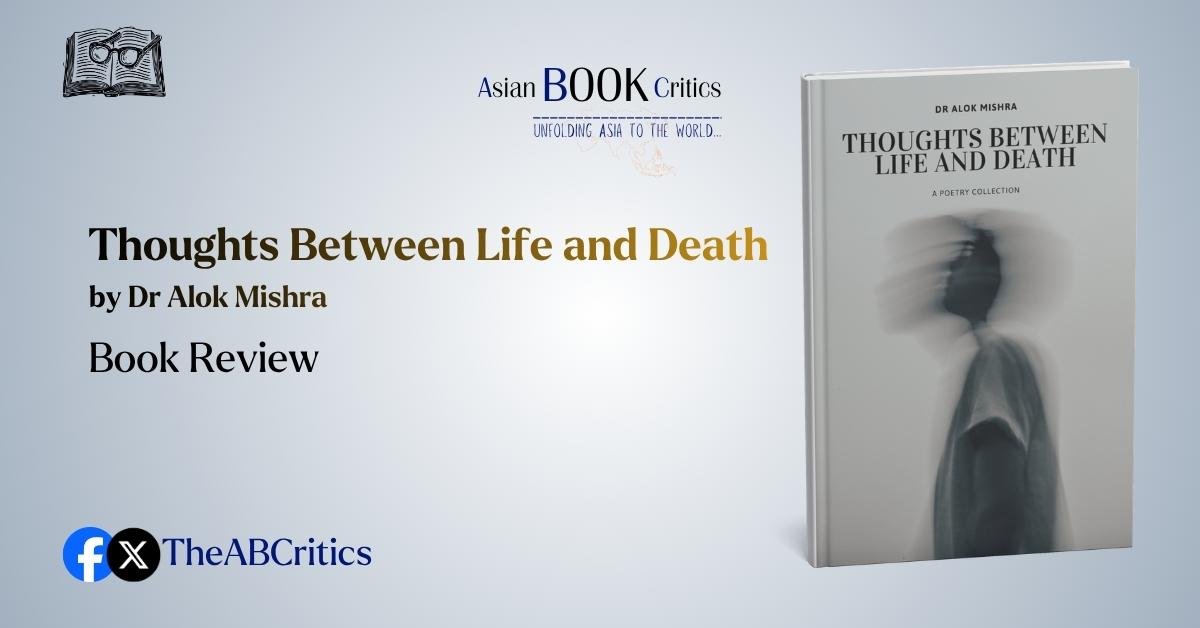
There is a persistent misconception in contemporary poetry that profundity is achieved through obscurity. Equally prevalent is the belief that poetry rooted in philosophy must inevitably surrender its emotional vitality in favour of abstract contemplation. Dr Alok Mishra’s Thoughts Between Life and Death challenges both assumptions with considerable confidence. It is not a collection that seeks to impress readers through linguistic acrobatics or deliberately enigmatic imagery. Instead, it attempts something considerably more ambitious: to transform philosophical inquiry into lived poetic experience. Throughout the volume, questions concerning mortality, love, identity, justice, loneliness, art, consciousness and transcendence emerge not as academic propositions but as intensely personal meditations. The poems occupy the fragile territory where emotional vulnerability encounters metaphysical curiosity, where the individual self repeatedly interrogates its own existence while recognising its inseparable relationship with the larger cosmic order.
The collection announces its philosophical orientation even before the first poem begins. The dedication refuses the conventional separation between subject and object, declaring, “What’s left / to dedicate? / What can I offer you? / The offering, the offerer, / the offered and who’s being offered to / is the same!” These lines immediately establish the non-dualistic framework within which the subsequent poems operate. The distinction between self and other, creator and creation, giver and receiver gradually dissolves, recalling Vedantic thought without reducing itself to religious exposition. Rather than quoting scripture or borrowing philosophical vocabulary directly, Mishra allows metaphysical ideas to emerge organically through poetic intuition.
The preface further clarifies the poet’s intentions. Mishra observes that poetry “stirs the minds and hearts, making readers travel to the unknown and see the unseen,” before describing the poems as “random episodes that occur between the beginning and the end.” He ultimately suggests that the collection celebrates “the life force, the unending, and that which never begins.” This statement is significant because it reveals the governing principle of the volume. These poems are not organised around narrative continuity or thematic progression. Instead, they resemble individual contemplative moments arising from the larger experience of being alive. Their apparent randomness conceals remarkable philosophical coherence.
One of the collection’s greatest strengths is its refusal to sentimentalise either love or suffering. Contemporary poetry often equates emotional authenticity with confessional disclosure. Mishra adopts a markedly different approach. Personal experiences certainly motivate many poems, yet they are consistently transformed into broader reflections upon existence itself. Consider the opening poem, “We Two Parted?” The familiar subject of separation is immediately stripped of melodrama:
“When we two parted,
there was no agony in either
of the two
who
lived all our lives together…”
The poem deliberately echoes Byron’s celebrated title while quietly overturning its emotional architecture. Instead of dwelling upon betrayal or loss, the speaker reflects upon an intimacy so complete that separation itself becomes difficult to conceptualise. The poem derives its power from restraint rather than emotional excess. It invites readers to contemplate relationships that transcend conventional categories of union and separation.
Such restraint becomes one of Mishra’s defining poetic virtues. Even when addressing intensely personal experiences, he consistently resists rhetorical indulgence. “The Lost Battle” exemplifies this tendency. The speaker wishes not for victory but simply “another opportunity / to experience and see, / fathom and breathe, / live with her and leave / the world on its own.” What begins as romantic remembrance gradually expands into existential longing. The lost battle is not merely the failure of love but humanity’s perpetual inability to inhabit fleeting moments fully before time transforms them into memory.
Perhaps the collection’s most intellectually provocative poems concern the nature of artistic creation itself. “The Art and the Artist” rejects simplistic notions of poetic justice, arguing instead that “The universe has a different rulebook.” Here Mishra enters an ongoing philosophical debate concerning human creativity and divine order. The poem questions whether art possesses sufficient autonomy to challenge the cosmic design established by its ultimate creator. The artist becomes creator and creation simultaneously, exercising imaginative freedom while remaining subject to laws beyond aesthetic invention. This metaphysical paradox recalls aspects of both Sri Aurobindo’s spiritual poetics and T. S. Eliot’s reflections upon tradition, though Mishra’s treatment remains distinctly his own.
Similarly compelling is “Heartbreak,” arguably one of the strongest poems in the collection. Contemporary literary culture has almost canonised the association between heartbreak and poetic inspiration. Mishra deliberately rejects this romantic mythology:
“No heartbreak can make a poet!
Poetry doesn’t stem from a broken heart…”
Instead, he proposes an alternative vision of poetry as creative transformation: “Poetry is creating flowers in the desert, / oceans on Neptune, and even Gods alive!” These lines reveal much about Mishra’s aesthetic philosophy. Poetry is not passive documentation of suffering but active imagination. The poet does not merely record pain; he constructs new realities from it. This conception restores creative agency to the poet and distances Mishra from the increasingly fashionable confessional mode dominating much contemporary verse.
The philosophical dimension of the collection becomes even more pronounced in poems such as “Justice” and “Unexpected.” “Justice” compresses an astonishingly complex meditation into a handful of lines. Declaring that “the jury and the executioner… are one and the same,” the poem dismantles anthropocentric conceptions of morality in favour of a cosmic perspective “untouched by the melodrama.” Such philosophical economy represents one of Mishra’s greatest strengths. He frequently succeeds in expressing difficult metaphysical ideas without resorting to elaborate abstraction.
“Unexpected” develops a similar insight through spiritual imagery. Darkness, conventionally associated with despair, unexpectedly becomes the source of illumination:
“The very darkness that drowned me deep
unfolded unto me
the eternal source of light…”
The poem recalls mystical traditions across cultures, where external darkness often precedes inward awakening. Yet Mishra carefully avoids doctrinal certainty. The experience remains personal rather than theological, preserving its emotional immediacy while inviting broader philosophical interpretation.
One recurring characteristic throughout the volume is the persistent dialogue between loneliness and transcendence. In “Upgrade,” loneliness initially appears destructive before gradually becoming transformative. The speaker admits that “Loneliness perturbed my existence,” only to discover that by weakening “the ropes of ego,” solitude ultimately leads towards expanded consciousness. The concluding paradox, “there is nothing to know; / there is nothing I don’t know,” beautifully encapsulates the epistemological humility underlying much Eastern philosophy. Knowledge culminates not in accumulation but in surrender.
This recurring influence of Indian philosophical traditions distinguishes Mishra from many contemporary Indian English poets whose work often privileges urban experience, political discourse or identity politics. While such concerns undoubtedly possess literary importance, Mishra directs his attention towards perennial philosophical questions. His poetry is less interested in documenting contemporary social realities than in investigating consciousness itself. This orientation inevitably invites comparison with poets such as A. K. Ramanujan, Jayanta Mahapatra, and, more distantly, Sri Aurobindo. Yet Mishra’s voice remains recognisably contemporary because he does not retreat into inherited symbolism. Even references to modern technology, as later poems demonstrate, coexist naturally with ancient metaphysical concerns.
Part II: The Poetry of Becoming
If the first half of Thoughts Between Life and Death introduces readers to Dr Alok Mishra’s philosophical concerns, the latter half demonstrates the remarkable consistency with which those concerns mature into a distinctive poetic vision. The collection gradually moves beyond personal reflections on love and separation to engage with larger questions concerning consciousness, mortality, language, artistic creation, and the paradoxical relationship between knowledge and innocence. It becomes increasingly evident that Mishra is less interested in narrating experience than in interpreting it. His poems are not records of events but meditations upon the meanings hidden beneath those events. In this respect, the volume participates in a long tradition of philosophical poetry that stretches from the metaphysical poets of seventeenth-century England to Rabindranath Tagore, Sri Aurobindo, and, in contemporary Indian English poetry, a comparatively small group of writers who continue to treat poetry as a vehicle of intellectual and spiritual exploration.
One of the collection’s most notable achievements is its sustained engagement with loneliness, not as an emotional deficiency but as a transformative state of being. Modern literature frequently portrays solitude as either psychological suffering or existential alienation. Mishra, however, repeatedly reimagines it as a necessary stage in spiritual evolution. In “Upgrade,” loneliness first appears destructive: “Loneliness perturbed my existence. / It pinched a thousand holes / in the animated case that stores / my ticket to eternity.” Yet the poem soon reverses this trajectory. By “weakening the ropes of ego,” the speaker discovers a more expansive consciousness, culminating in the paradoxical declaration, “there is nothing to know; / there is nothing I don’t know.” This movement from fragmentation to wholeness encapsulates one of the collection’s central philosophical propositions: suffering does not merely wound the self; it dismantles the illusions that prevent genuine understanding. The poem quietly echoes Advaita Vedanta’s insistence that true knowledge emerges through the dissolution rather than the strengthening of individual identity.
A similar philosophical intensity informs “Wide Blue Horizon,” arguably the collection’s most ambitious poem. Beginning with an almost cinematic vision of the speaker observing his own body, the poem develops into an extended meditation on death, perception, and consciousness. The surreal image of the self asking, “I am dying… or am I dead?” before recognising that thirst has merely awakened him from a dream immediately recalls philosophical thought experiments concerning selfhood. Yet Mishra unexpectedly situates this existential inquiry within contemporary technological reality. References to LED screens and artificial intelligence sit comfortably beside Brahma, sages, and cosmic speculation. Such juxtapositions could easily have appeared forced, but here they reinforce the poet’s broader argument that humanity’s deepest metaphysical questions remain unchanged despite technological advancement. Whether consulting scriptures or algorithms, the human mind continues searching for answers to questions that perhaps resist definitive resolution.
The poem’s concluding lines are particularly striking:
“Am I not death, the dead, dying and the one to die?
Until the day comes, let me try
once again to solve the puzzle of life.”
This is not merely an expression of existential uncertainty. Rather, it represents an attempt to transcend conventional distinctions between life and death altogether. The title of the collection itself acquires fresh significance here. “Between” does not indicate a temporal interval but a philosophical condition in which existence continually oscillates between opposing states without fully belonging to either.
The shorter poems scattered throughout the volume deserve equal attention because they reveal Mishra’s increasing confidence in poetic compression. Poems such as “Truth,” “Meditation,” and “Sacrifice” demonstrate that philosophical insight need not depend upon elaborate verbal architecture. “Truth” consists of only a few lines:
“What you speak
and I hear, seldom matters
more than what we perceive,
and deceive
in attempts to survive.”
Its brevity recalls the aphoristic traditions of Indian philosophical writing while simultaneously functioning as modern free verse. Similarly, “Meditation” reduces contemplative practice to a state where “Eyes wide open, / ears letting pass / the noises without bother.” These poems succeed because they resist ornament. They invite reflection through understatement rather than explanation.
Among the collection’s finest achievements is “Watching Sunset, Under the Tree,” which represents the emotional and philosophical culmination of the volume. Unlike many earlier poems that remain largely interior, this work develops through sustained engagement with an external object: an ageing tree that has silently accompanied the speaker throughout life. The poem begins with nostalgic remembrance before gradually becoming an exploration of mortality, gratitude, ecological consciousness, and spiritual acceptance. Particularly moving are the speaker’s rhetorical questions:
“How do we offer our hopes a ladder?
How do we show the Sun a candle?…
How do we give a walking stick to ageing fathers?”
These questions derive their power from their apparent impossibility. They articulate the universal human desire to protect those who have always protected us. The tree becomes parent, teacher, witness, and companion simultaneously. When the speaker finally acknowledges that “the universe has its cosmic pattern / that does not regard emotions,” yet confesses that he “cannot accept” this truth, Mishra captures one of the deepest contradictions of human existence. Philosophical understanding does not necessarily eliminate emotional resistance. Wisdom and grief frequently coexist.
This poem also illustrates Mishra’s most distinctive stylistic quality: his ability to weave metaphysical speculation into concrete emotional situations. Earlier in the collection, philosophical assertions occasionally risk becoming abstract. Here, however, philosophy emerges naturally from lived experience. The ageing tree grounds the poem in physical reality while simultaneously functioning as an expansive symbol of continuity, impermanence, and interdependence. It is undoubtedly one of the strongest pieces in the collection and reveals what Mishra’s poetry achieves when philosophical inquiry remains inseparable from sensory experience.
The concluding poem, “Mind and Heart,” offers perhaps the collection’s most provocative artistic statement. Rather than celebrating wisdom uncritically, Mishra subjects it to severe scrutiny. Wisdom becomes “the ringleader / of thugs, criminals, robbers and murderers,” capable of concealing “the innocent truth” beneath elaborate constructions of craft and interpretation. This reversal is fascinating because it challenges conventional literary assumptions. Throughout much of Western literary theory, artistic sophistication is regarded as an unquestionable virtue. Mishra instead suggests that excessive craft may obscure authenticity. The poem does not reject artistic excellence; rather, it warns against allowing technical brilliance to replace emotional truth. It is an audacious conclusion for a poetry collection and one that will undoubtedly invite critical debate.
From a stylistic perspective, Mishra’s poetry occupies an intriguing middle ground between lyricism and reflective prose. His free verse is deliberately uncluttered, favouring conversational rhythms over intricate metrical structures. This stylistic simplicity renders the poems immediately accessible, though it occasionally limits their musical richness. Readers seeking elaborate sonic patterning or densely layered metaphor may find the language deceptively plain. Yet this apparent simplicity often conceals considerable conceptual sophistication. Mishra trusts thought itself to generate poetic momentum rather than relying exclusively upon linguistic ornamentation.
There are, however, aspects of the collection that merit critical reservation. One recurring limitation concerns the balance between philosophy and image. Several poems articulate compelling ideas but could benefit from richer sensory embodiment. Poetry ultimately communicates most powerfully when abstract thought becomes inseparable from concrete experience. At times Mishra arrives at philosophical conclusions before allowing imagery sufficient space to unfold. Consequently, certain poems resemble meditative reflections arranged in poetic lines rather than fully realised lyric experiences.
A second limitation involves tonal consistency. The collection maintains a remarkably earnest philosophical voice from beginning to end. While this coherence contributes to its intellectual unity, greater tonal variation might have enriched the reading experience. Moments of irony, humour, narrative experimentation, or dramatic dialogue could have provided productive contrasts to the prevailing contemplative mood. Similarly, a few conceptual motifs—truth, eternity, wisdom, cosmic order, ego, and mortality—recur frequently enough that some readers may desire greater thematic diversification.
Alok Mishra’s intellectual confidence occasionally becomes both strength and weakness. Certain poems privilege philosophical assertion over sensory experience. Readers expecting dense imagery or dramatic narrative may occasionally find the poems more meditative than lyrical. The poet often states his insights directly rather than allowing imagery alone to generate meaning. While this approach enhances conceptual clarity, it sometimes reduces interpretative openness. A few poems would have benefited from greater symbolic development before arriving at philosophical conclusions.
Similarly, abstraction occasionally outweighs emotional texture. Mishra frequently speaks of truth, justice, wisdom, eternity, consciousness, and the cosmic order. These ideas possess undeniable philosophical richness, yet poetry ultimately flourishes through concrete experience. At his finest, as in “Heartbreak,” “Unexpected,” or “We Two Parted?”, the abstract emerges naturally from lived emotion. Elsewhere, philosophical vocabulary occasionally dominates the poetic landscape.
Yet these reservations remain relatively minor within the larger achievement of the collection. Thoughts Between Life and Death represents a rare attempt to recover poetry as a serious mode of philosophical inquiry without sacrificing emotional accessibility. It refuses fashionable cynicism, rejects performative despair, and resists literary exhibitionism. Instead, it invites readers into an ongoing meditation concerning the deepest questions of human existence.
Thoughts Between Life and Death distinguishes itself within contemporary Indian English poetry precisely because it resists prevailing literary fashions. It neither pursues political urgency for its own sake nor indulges in confessional exhibitionism. Instead, it attempts to restore poetry to one of its oldest functions: the disciplined exploration of existence. Such ambition inevitably invites comparison with philosophical poets rather than merely contemporary lyric writers.
Dr Alok Mishra himself occupies an interesting position within Indian literary culture. Better known in many circles as a critic, editor, reviewer, and literary organiser, he approaches poetry with the analytical awareness of someone deeply immersed in literary discourse. Such awareness can occasionally become burdensome for poets, encouraging self-consciousness at the expense of spontaneity. Remarkably, Mishra largely avoids this danger. Although traces of the critic occasionally surface in his conceptual precision, the poems retain genuine emotional sincerity. His literary scholarship informs rather than dominates his creative voice.
Perhaps the most significant quality of Thoughts Between Life and Death is its refusal to offer definitive answers. Despite its philosophical confidence, the collection consistently values questioning above certainty. Life, death, love, justice, truth, and consciousness remain open inquiries rather than settled doctrines. This intellectual humility ultimately becomes the collection’s greatest strength. Mishra understands that poetry does not exist to solve metaphysical problems but to deepen humanity’s engagement with them.
In an era when much contemporary poetry strives for immediacy, topical relevance, or autobiographical transparency, Thoughts Between Life and Death offers something increasingly uncommon: a sustained philosophical meditation written with emotional honesty and artistic conviction. It is not a flawless collection. Certain poems would gain greater resonance through richer imagery and increased formal experimentation. Yet its imperfections arise from the risks it willingly embraces rather than from artistic hesitation. Few contemporary poets attempt to engage so directly with the fundamental questions of existence, and fewer still sustain such inquiry across an entire collection without lapsing into didacticism.
Ultimately, Thoughts Between Life and Death is less a sequence of poems than a record of consciousness in dialogue with itself. It asks readers not simply to appreciate poetic language but to accompany a thinking mind as it negotiates the fragile territory between certainty and mystery, attachment and detachment, life and what lies beyond it. In doing so, Dr Alok Mishra establishes himself not merely as a poet of emotion but as a poet of contemplation, one whose work deserves serious attention within the evolving landscape of contemporary Indian English poetry.
Get a copy from Amazon India – click here.
Adarsh for Asian Book Critics