
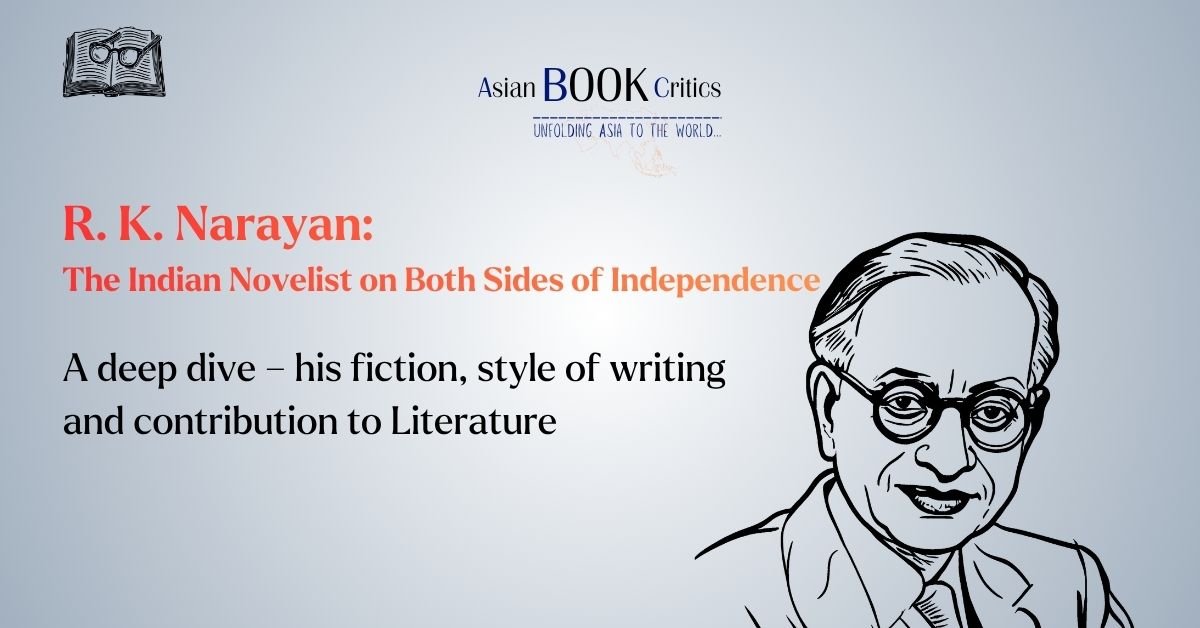
There is something quietly enduring about R. K. Narayan, something that resists both historical noise and literary fashion. He did not shout. He did not proclaim manifestos. He did not position himself as a prophet of change or a chronicler of catastrophe. And yet, across decades that witnessed colonial rule, the turbulence of independence, and the uncertain shaping of a new nation, Narayan remained one of the most faithful interpreters of Indian life. To read him today is to realise that he was doing something far more subtle than merely telling stories. He was holding together two Indias, one that was passing away and one that had not yet fully arrived, and he was doing so with a patience that few of his contemporaries could sustain.
Though these tall claims might appear hyperbolic to those who haven’t read Narayan yet, these are facts! Readers who have had the pleasure of reading R. K. Narayan’s writings may countersign these exclamations.
Narayan began writing at a time when India was still under British rule, and the literary atmosphere was charged with political urgency. Many writers, quite understandably, turned toward nationalism, resistance, and ideological assertion. Literature became a vehicle for awakening, for protest, for collective identity. In such a context, Narayan’s choice appears almost unusual. He did not directly engage with political rhetoric. He did not centre his narratives on revolution or colonial confrontation. Instead, he turned his attention to the small town of Malgudi, a fictional space that would become one of the most recognisable settings in Indian English literature. At first glance, this may seem like a retreat from history. But it is not. It is a reorientation.
Malgudi is not a place outside history. It is a place where history quietly settles into daily life. The colonial presence is there, but it does not dominate the narrative. It appears in institutions, in education, in administrative structures, in subtle cultural shifts. Narayan’s genius lies in showing how these forces shape ordinary people without reducing them to symbols of resistance or submission. In Swami and Friends, for instance, the colonial school system becomes a site of both discipline and childhood rebellion. The novel captures the texture of growing up under colonial rule without turning the child into a political instrument. Swami is not a nationalist hero. He is a boy navigating friendship, fear, and authority. And yet, through him, we glimpse the emotional climate of a colonised society.
There is a certain restraint in Narayan’s early work that deserves attention. He does not dramatise conflict beyond what is necessary. He allows situations to unfold with a natural rhythm. This is where his social realism takes a distinctive form. It is not the realism of grand events or sweeping narratives. It is the realism of habit, of routine, of minor disruptions. A missed train, a school examination, a domestic disagreement, these become the building blocks of his fiction. In this sense, Narayan aligns himself with a tradition of realism that values observation over proclamation. He trusts that the ordinary contains its own significance.
And yet, within this realism, there is also an ideal vision of society, though it is never presented as perfection. Narayan’s world is flawed, sometimes gently absurd, and occasionally unjust. But it is also held together by a sense of continuity, of shared understanding. There is a belief, however fragile, that life will go on, that relationships will endure, that even failure has a place within the larger rhythm of existence. This balance between realism and idealism is what gives his early work its quiet strength. He does not deny the limitations of his characters. He simply refuses to strip them of dignity. And, looking closely, this is what distinguishes Narayan from his immediate peers, Raja Rao and Mulk Raj Anand.
As India moved toward independence, the tone of Narayan’s writing did not change abruptly, but the undercurrents deepened. The transition from colonial rule to self-governance was not merely a political shift. It was an emotional and psychological reorientation. Expectations rose, uncertainties multiplied, and the idea of India itself began to acquire new meanings. Narayan responded to this transformation not through overt commentary but through the evolution of his characters and situations. In The Bachelor of Arts and The English Teacher, we see individuals grappling with questions of purpose, identity, and personal fulfilment. The colonial framework is still present, but it is no longer the central concern. The focus shifts inward.
This inward turn becomes even more pronounced in his post-independence works. Novels such as The Financial Expert, Waiting for the Mahatma, and The Guide reflect a society negotiating freedom in practical, often messy ways. Here, Narayan’s realism acquires sharper edges. The characters are still recognisably ordinary, but their struggles now intersect with the broader changes taking place in the country. Margayya in The Financial Expert embodies the aspirations and anxieties of a newly mobile society. Raju in The Guide becomes one of Narayan’s most complex creations, a man whose journey from tourist guide to spiritual figure reflects both the possibilities and the illusions of post-independence India.
It is in The Guide that Narayan’s balance between realism and idealism reaches a remarkable intensity. Raju is not an ideal hero. He is flawed, opportunistic, and often self-deceptive. And yet, through a series of circumstances, he is transformed into a figure of spiritual significance. The novel does not straightforwardly resolve this transformation. It leaves the reader in a space of ambiguity. Is Raju a fraud who becomes genuine, or a genuine seeker who begins as a fraud? The answer is deliberately uncertain. What matters is the process, the slow movement toward responsibility, the recognition that even flawed individuals can arrive at moments of truth. This is Narayan’s vision of society; not perfect, not heroic, but capable of moral growth.
In comparison with his contemporaries, Narayan occupies a distinct position. Writers such as Mulk Raj Anand and Raja Rao engaged more directly with social and philosophical questions. Anand’s work is marked by a strong commitment to social justice, often depicting the harsh realities of caste and class oppression. Raja Rao, on the other hand, brings a philosophical and metaphysical depth to his narratives, exploring the intersection of Indian thought and modern experience. Narayan, by contrast, appears quieter, less overtly engaged. But this apparent simplicity should not be mistaken for a lack of depth. His contribution lies in his ability to normalise the Indian experience in English fiction, to present it without exoticism or excessive explanation.
Narayan’s language is another aspect of his enduring appeal. He writes in a prose that is clear, unadorned, and deceptively simple. There are moments when his sentences seem almost transparent, allowing the reader to move effortlessly through the narrative. And yet, beneath this simplicity lies a careful control of tone and rhythm. He knows when to pause, when to shift perspective, and when to introduce humour. His humour, in particular, is worth noting. It is gentle, often self-aware, never cruel. It allows him to address serious themes without becoming heavy-handed. In a way, humour becomes his method of critique. He exposes the absurdities of social behaviour not through anger but through quiet observation.
If one were to adopt a more cryptic reflection, perhaps in the spirit of a meditative aside, one might say this: Narayan writes as though time itself were seated beside him, listening. Not rushing, not demanding resolution, simply waiting for the story to reveal its own necessity. His characters do not arrive with declarations. They unfold, slowly, like thoughts that have been waiting to be recognised. In that unfolding lies his truth.
The influence of Narayan on later Indian writers is both direct and subtle. Writers such as Rohinton Mistry, Ruskin Bond, and even Arundhati Roy, in a different register, inherit aspects of his approach. Mistry’s detailed social realism, Bond’s affection for small-town life, and Roy’s attention to the emotional lives of ordinary people all resonate, in different ways, with Narayan’s legacy. At the same time, later writers have expanded the scope of Indian English fiction, engaging more directly with politics, history, and globalisation. In this broader landscape, Narayan’s work stands as a reminder of another possibility, a literature that does not seek to dominate the reader but to accompany them.
What, then, does it mean to say that Narayan represented India both before and after independence? It means that he captured continuity without denying change. He showed that while political structures may shift, the rhythms of daily life persist. He understood that independence would not immediately resolve social contradictions. Instead, it would introduce new ones. His fiction reflects this understanding with remarkable consistency. The India of Malgudi evolves, but it does not lose its essential character. It remains a place where people struggle, hope, fail, and begin again.
There is also a deeper ethical dimension to Narayan’s work. He does not impose moral judgment from above. He allows characters to reveal themselves through action and consequence. This creates a sense of moral openness. Readers are invited to reflect rather than to accept predefined conclusions. In a time when literature often aligns itself with strong ideological positions, this openness feels particularly valuable. It reminds us that understanding is not the same as agreement, and that empathy can exist alongside critique.
Toward the later years of his career, Narayan’s writing retains its clarity and composure. Novels such as The Man-Eater of Malgudi and Talkative Man continue to explore the quirks and contradictions of human behaviour. There is a sense that he had found his rhythm and remained faithful to it. He did not chase trends. He did not attempt to reinvent himself for changing literary markets. Instead, he continued to write the stories that interested him, trusting that their value lay in their honesty.
To return to where we began, Narayan’s enduring appeal lies in his refusal to separate literature from life. He does not elevate the writer above the world. He places the writer within it, observing, listening, and occasionally smiling. His India is not a spectacle. It is a lived space, inhabited by people who are neither heroes nor victims in any absolute sense. They are simply human.
In an age that often demands intensity, immediacy, and grand narratives, Narayan offers something different. He offers patience. He offers attention. He offers a way of seeing that recognises the significance of the ordinary. And in doing so, he represents not only a particular historical moment but a continuing possibility for literature itself.
Amit Mishra for Asian Book Critics