
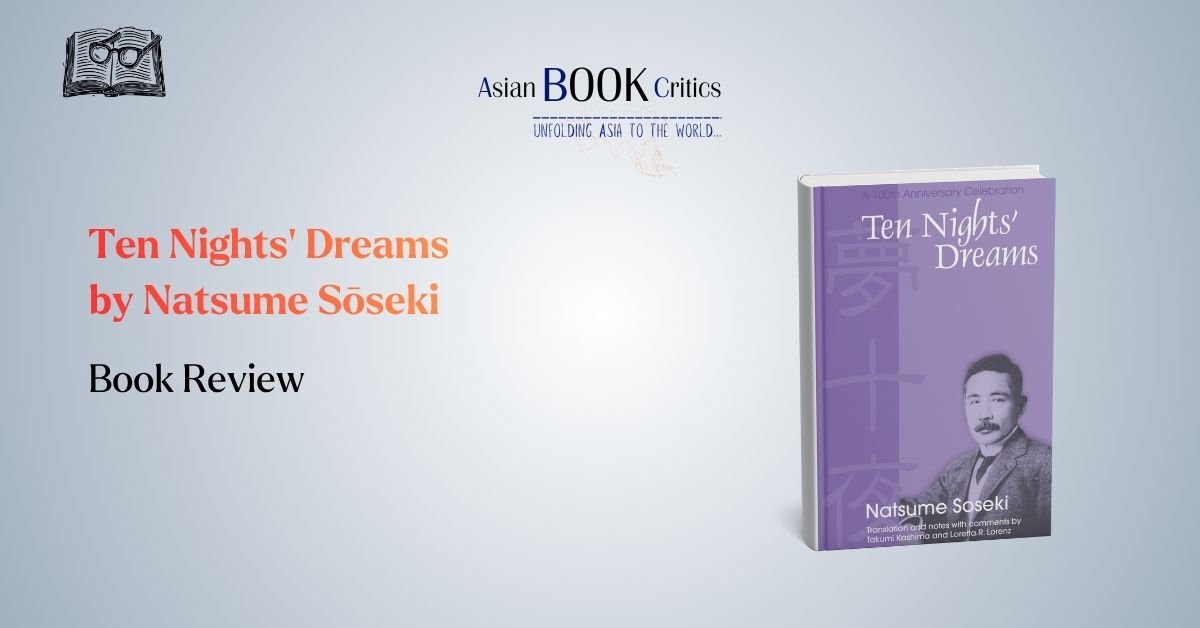
Natsume Sōseki’s Ten Nights of Dreams is a slender yet profoundly evocative work that resists easy categorisation, and perhaps that is precisely its enduring charm. Composed as a series of ten dream narratives, often categorised as short stories, each unfolding in its own peculiar emotional and philosophical register, the book invites the reader into a liminal space where reality dissolves, and the subconscious assumes narrative authority. What begins as a collection of seemingly disjointed dream episodes gradually reveals itself as a deeply coherent meditation on time, mortality, longing, spiritual anxiety, and the fragile boundaries between the self and the world. The density of imagery and thematic resonance is unmistakable, which helps explain why Sōseki remains such a towering figure in Japanese literature.
As soon as one begins reading, the grip begins to be felt. The opening dream immediately establishes the tone of quiet intensity that pervades the work. The narrator sits beside a woman who calmly declares that she is about to die, a moment rendered with unsettling composure rather than overt drama. The emotional restraint in this scene is striking; skilled readers may note that immediately. There is no melodrama, no exaggerated grief. Instead, there is a peculiar stillness that allows the reader to focus on the symbolic dimensions of the encounter. The woman’s request that the narrator wait for her for a hundred years transforms the narrative from a simple deathbed scene into a meditation on time and devotion. As described in the text, the narrator fulfils this request, waiting by her grave as nature continues its indifferent cycles, until finally a white lily blooms from the grave, marking the completion of the promised time. This transformation of time into something both immense and intimate is characteristic of Sōseki’s dream logic. The passage does not ask whether such waiting is possible or reasonable. Instead, it compels the reader to inhabit the emotional truth of the act.
What is particularly compelling about this first dream is its treatment of time not as a linear progression but as an experiential condition. The narrator does not merely count years. He endures them. The passage of a century is compressed into a sequence of sensory impressions, suggesting that time, in the dream world, is measured less by chronology and more by emotional persistence. This resonates with broader philosophical concerns about memory and attachment. The narrator’s act of waiting becomes a form of existential commitment, one that transcends ordinary human limitations. Yet the eventual blossoming of the lily introduces ambiguity. Is this a fulfilment of the woman’s promise, or merely the narrator’s projection of meaning onto natural processes? Sōseki leaves this question deliberately unresolved, allowing the dream to linger in a state of interpretive openness.
The subsequent dreams continue this exploration of inner states, often juxtaposing spiritual aspiration with human frailty. One particularly striking episode involves a samurai who is told that he must attain enlightenment. The narrative traces his increasingly desperate attempts to achieve this state, culminating in intense physical and psychological strain. The language used to describe his efforts conveys a palpable sense of frustration and futility. Despite his determination, enlightenment remains elusive, slipping away just as he seems on the verge of grasping it. This dream can be read as a critique of rigid notions of spiritual attainment, particularly when pursued through force or ego. The samurai’s identity, rooted in discipline and honour, becomes an obstacle rather than an aid. His struggle underscores the paradox that enlightenment, often conceived as a goal to be achieved, may in fact resist such instrumental approaches.
Sōseki’s engagement with Buddhist ideas is evident here, though it is far from doctrinaire. Instead of offering clear philosophical resolutions, he dramatises the tensions inherent in spiritual striving. The samurai’s ordeal suggests that the very desire for enlightenment may be what prevents it. This insight aligns with certain Zen teachings, yet Sōseki presents it in a way that is deeply human rather than abstractly philosophical. The reader does not encounter a serene sage but a tormented individual grappling with his own limitations. This emphasis on lived experience, rather than theoretical exposition, is one of the work’s greatest strengths.
Another dream shifts the setting to a ship at sea, where the narrator observes fellow passengers and becomes increasingly preoccupied with existential questions. The vastness of the ocean serves as a powerful metaphor for isolation and uncertainty. The passengers, described as indifferent and detached, seem disconnected not only from one another but from themselves. The narrator’s contemplation of suicide emerges not as a dramatic gesture but as a quiet, almost logical response to a sense of meaninglessness. Yet when he finally leaps into the sea, he experiences a sudden reversal. Life, which had seemed empty, becomes intensely precious in the very moment of its apparent loss. This reversal is handled with remarkable subtlety. There is no moralising, no explicit lesson. Instead, the reader is left to grapple with the irony that awareness often arrives too late.
What makes this dream particularly effective is its interplay between external and internal landscapes. The sea is not merely a setting but an extension of the narrator’s mental state. Its vastness mirrors his sense of insignificance, while its depth suggests the unknown dimensions of existence. The ship, moving steadily yet aimlessly, becomes a symbol of human life itself, propelled forward without a clear purpose. Sōseki’s ability to fuse physical environment with psychological insight is evident throughout the work, and this dream provides a particularly vivid example.
The later dreams introduce elements of folklore and social commentary, further enriching the text’s thematic range. One poignant narrative centres on a mother and child who visit a shrine, praying for the return of a father who has already been killed. The tragic irony of the situation is revealed only at the end, when it becomes clear that the mother’s devotion is directed towards an impossibility. The child’s innocent responses, repeating phrases without understanding their implications, add an additional layer of emotional complexity. The scene is imbued with a quiet sorrow that is characteristic of Sōseki’s style. Rather than emphasising the tragedy through dramatic exposition, he allows it to emerge gradually, almost imperceptibly, until it settles into the reader’s consciousness with lasting force.
This dream also highlights Sōseki’s sensitivity to the rhythms of everyday life. The mother’s repeated actions, her prayers, her movements between the shrine and the path, create a sense of ritual that is both comforting and futile. The repetition underscores the persistence of hope even in the face of overwhelming evidence to the contrary. It is this tension between hope and reality that gives the narrative its emotional depth. The dream does not offer resolution. The father does not return. Yet the mother continues her prayers, suggesting that faith, however misplaced, is an integral part of human experience.
Across all ten dreams, Sōseki demonstrates a remarkable ability to capture the fleeting, often contradictory nature of human consciousness. The narratives are brief, yet they are densely packed with imagery and implication. Each dream functions as a self-contained unit, yet they collectively form a larger meditation on existence. The absence of explicit connections between the dreams is not a weakness but a deliberate stylistic choice. It mirrors the way dreams themselves operate, moving from one scene to another without clear transitions, yet often guided by underlying emotional currents.
The language of the text, even in translation, retains a lyrical quality that enhances its impact. Descriptions are precise yet suggestive, allowing the reader to visualise scenes while also engaging with their symbolic dimensions. The imagery of nature, in particular, plays a central role. Flowers, the sea, the night sky, and other natural elements recur throughout the dreams, serving as both settings and symbols. They provide a sense of continuity across otherwise disparate narratives, reinforcing the idea that human experiences are embedded within a larger, often indifferent, natural world.
What ultimately distinguishes Ten Nights of Dreams is its refusal to impose definitive meanings. Each dream invites interpretation, yet none demands it. This openness allows the work to resonate differently with each reader, depending on their own experiences and perspectives. For some, the dreams may appear as philosophical allegories. For others, they may function as psychological explorations or even as poetic impressions. Sōseki’s genius lies in his ability to accommodate all these readings without privileging any single one.
In a broader literary context, the work can be seen as anticipating modernist concerns with subjectivity and fragmentation. Long before such themes became central to Western literary movements, Sōseki was already experimenting with narrative forms that prioritised internal experience over external plot. The dream structure allows him to bypass conventional storytelling constraints, enabling a more direct engagement with the subconscious. At the same time, the cultural specificity of the work, particularly its engagement with Japanese aesthetics and philosophical traditions, gives it a distinct identity that resists homogenisation.
Reading Ten Nights of Dreams is not a passive experience. It requires a willingness to embrace ambiguity, to linger in moments of uncertainty, and to accept that not all questions will be answered. Yet it is precisely this quality that makes the work so rewarding. The dreams do not simply entertain. They provoke, unsettle, and invite reflection. They remind us that beneath the surface of everyday life lies a complex and often contradictory inner world, one that cannot be fully captured through conventional narrative forms.
In the end, Sōseki’s work leaves a lingering impression that is difficult to articulate yet impossible to ignore. The images remain, the emotions persist, and the questions continue to echo long after the final page has been turned. It is a book that does not conclude so much as it dissolves, much like a dream itself, leaving behind traces that shape the reader’s perception in subtle and enduring ways.
Get a copy from Amazon India – click here to buy one.
Review by Sanjay for Asian Book Critics